Another day past.
I felt skittish in my Calc I classes today, and awkward. I felt elsewhere, out-of-place, out-of-sync.
MATH 280 made up for it, though. I was definitely at home in Karpen 033 this afternoon.
This afternoon, I started thinking about what I'd like to talk about at a Writing Across the Curriculum conference.
What do I have to say?
What am I qualified to say?
Hey, even if I have to say so myself, I think I'm pretty damned good at teaching math students how to write math...but is that enough? I don't know how hardcore into the scholarship of teaching and learning I'm expected to be in order to "have something to say."
I'd like to talk about my rubric-building exercises: how does one set out to teach math students to teach themselves what to look for most in quantifying quality in math writing? How does one teach them that, given a few ground rules and a little practice, they are as qualified as I am to render an assessment of a proof's goodness?
Good enough?
Hmmmm...there's a kernel of irony here, isn't there?: maybe I've just got to teach myself that I am as qualified as anyone else is to render an assessment on the goodness of my own writing-instruction methods, at least in the context of my own classroom.
Is it that easy, or is that just a bunch of relativistic hooey?
Ah, fugeddaboutit.
I'm going to go rustle up something to eat.
To be continued, for sure.
Monday, August 27, 2007
Mirror, mirror, on the wall...

Friday, August 24, 2007
A doughnutty day
Oof.
How many doughnuts does it take to fill a coupla Calc I classes?
Evidently not as many as I'd expected. I got six dozen tummy-busters this morning (yep, that's 72 doughnuts) at Krispy Kreme on my way into campus; I thought it might make a nice end-of-the-first-week-of-class gift for my calculus compadres. With 63 students, I thought maybe I'd have a few doughnuts left over after the carnage had ended. I finished up with something closer than two full dozen to spare, and that's after I'd had my own unhealthily large share.
Mathwise, in Calc I today we rummaged about in a pile of various useful models: polynomials, root functions, rational functions, transcendental functions of various sorts. On Monday we'll work at building new functions from old ones. I was a bit bored in today's class (although it was likely difficult for the students to tell; as usual, I got a number of comments regarding my characteristically high energy level), I don't feel I got the students to do enough today. Geez Louise, I've finally gotten to the point in my career where I feel out-of-sorts if I talk for more than 10 minutes in a row in class.
Meanwhile, today marked the first entirely-math-related day for my 280 folks. We started our discussion of mathematical statements, comparing the notions of validity and truth, introducing the notion of a "grammatically correct" ("well-formed") mathematical statement, universal quantifiers, existential quantifiers, and order of quantification. I handed out the first homework assignment and exhorted folks to get a jump on Exercise #2, solutions to which are due to the first HW Committee on Monday. (This exercise asks them to come up with their own mathematical statement involving a universal quantifier and an existential one such that when the order of the quantifiers is reversed, the truth value of the statement is negated.)
In between classes, I was as busy as a caffeine-addled (or doughnut-sugar-soaked) bumblebee. Though I did have an hour or two in which to start re-reading a paper I'm hoping to work on with one of my colleagues here, and to chase down another dead end in the random tree project, meet 'n' greet sessions with students filled much of my time. I've now met with about half of my new students, and as usual have been awed by the diversity of people who come into my classroom. Some are confident mathematics practitioners who come equipped with eagerness and excitement, others are trepidatious, to put it mildly. Some are fully aware of their own particular study habits and learning styles, others haven't a clue what I'm talking about when I ask after the techniques that help them learn best. ("I dunno, I just do the problems, maybe look at some examples," is a common response. I'm always heartened when a student quickly tells me, "oh yeah, it really helps me to draw a picture to help understand," or "when I explain it to my friend, I really catch on.") Variety, variety: one 280 student I met with today credited his math classes with giving him the ability think more clearly and to improve his memory, while one of my calc students unhesitatingly mentioned her math anxiety and indicated that she merely hopes to finish out the class with a better grade than she earned the last time around.
They're a good lot.
Well, off to bed. Tomorrow brings my first grading session of the new semester, I've got a thick stack of calculus homework to peruse. We'll see how the new grading system works out.
Thursday, August 23, 2007
Conversations
Had a little doorway chat with Karl (longtime Math Lab student employee, now graduated) this afternoon about the universality (or lack of it) of mathematics: to what extent is math just waiting around for us to discover it, and to what extent is math itself an artifact of human invention, the residue that's left by the human mind as it makes its imprint on all that it encompasses? The whole conversation started when I was showing him a book of logarithm tables I picked up at a garage sale or flea market somewhere a long time ago, and I wavered indecisively between the words "invented" and "discovered" when searching for the right word to describe the initial human engagement with logarithms.
"Since you said 'invented' first," said Karl, "I can tell which camp you're in." This led to a discussion of whether mathematics can truly be universal, a position neither of us defends. Karl mentioned recent research (see this link for more info) into the language of a certain Amazonian people suggesting limits to traditional Chomskian analysis, and I let him know about Anthony F. Aveni's Uncommon sense: understanding nature's truths across time and culture (University Press of Colorado, Boulder, 2006), an interesting book I worked my way through this summer. Aveni discusses the scientific undertakings of the members of various ancient and modern societies and provides accounts of culture-specific scientific knowledge that might seem patently alien to practitioners of science as defined by the Western European Enlightenment tradition. I'll definitely be looking through that text again when I start to put together my thoughts on the history of math technology course I hope to run.
Rewind several hours: as I walked into campus this morning I thought about our discussion on the topic of "Good Proof/Bad Proof" in 280 yesterday. "Damn," I thought, "that was a nice conversation." I really felt that we got right at the meat of the matter (or whatever vegetarian substitute one would like to put in its stead), and the students themselves were quick to point out, unprompted, what it is that makes a given proof a weak one or a strong one: does it use notation correctly? Consistently? Does it prove the claimed statement in full generality? Does it use correct grammar and punctuation, use complete sentences? Does it "lead the reader" conversationally through the thought processes of the prover? All of these questions get at the issues of clarity, correctness, completeness, and cohesion, my "Four Cs" of assessing the quality of a proof. Above all else, the exercise helped them develop (oh, that meaning-laden term!) "ownership" of the process of mathematical discovery: they have the same right that I do to question the validity of a proof, to test the hypotheses of a theorem. Math's truth does not inhere in a single individual no matter how much experience that individual possesses, and even the greenest of mathematical parvenus, equipped with the right tools and techniques, may approach, with healthy skepticism, a given mathematical statement with the confidence of a professor emeritus. I think that yesterday's exercise helped folks see that, and I hope that it gave them the confidence they'll require to feel free to explore the problems we'll face the rest of the semester.
I'm really glad we took time out for that activity.
Wednesday, August 22, 2007
Hmmm...
Good day, folks, it's been a good day.
I spent most of my free time today beating my brains senseless (a misleading phrase which seems to suggest that there was some sense in there in the first place) on a couple of twisted research problems I'm working on with my colleague Tip: after a month or so of work we've managed to get a handle on the expected degree, at time t, of the nth vertex constructed through applying any one of an infinite family of random tree construction algorithms. At this point we're trying to recover the same statistic for a broader class (or other related classes) of algorithms, and to no avail.
Hey, and every now and then I took a break and taught a couple of classes!
I felt much more comfortable in Section 1 of my Calc I class this morning. (I made damned sure that the classroom door was open before traipsing up to my office so that I wouldn't be greeted by a hulking phalanx of students waiting outside the locked door.) After going over a few bureaucratic points I'd intentionally let slide on Monday, we spent about twenty minutes figuring out what sort of grading system we wanted for the HW: as planned, I split everyone into groups of four and asked them to consider, if they would, the weight the wanted to assign to each of the sets of HW problems graded in a certain fashion. (Details are on the syllabus; roughly, a fraction of the problems, selected randomly as I've done in the past, will be graded "carefully," lots o' juicy feedback and whatnot, while the remainder will be graded "quickly," based solely on whether or not the correct answer was obtained. All told, 20% of the overall grade will come from HW graded in one way or another.) After reaching a consensus within each group, we reconvened and briefly discussed the pros and cons of each grading system. Each group then reported the figures arrived at, and we agreed to go with the straight average of the resulting weights. In Section 1, we ended up with something like 65/7% for the "careful" method and 75/7% for the "quick" method, and everyone seemed pretty satisfied. The same exercise, run by the second section, yielded a more arcane division that we decided to round off to 5% "careful," 15% "quick." Though there wasn't out-and-out rebellion, I sensed a little bit more resistance to this decision. I asked anyone who was unhappy with the result to let me know confidentially, in case they didn't want to be put on the spot in front of 30 of their peers.
Once all of those parliamentary matters were out of the way, it was time for...MATH! Oh boy! We actually ran short of time in the second section, having spent a few more minutes still on discussing what it is that students and teachers can do to work together in bringing about a classroom atmosphere conducive to effective learning. (This discussion yielded a wealth of good ideas, and everyone seemed to agree that the best environment involves an active classroom in which a variety of learning styles were addressed and in which both teacher and student come prepared to play their respective parts. Duh.) Even in the first section we only got to scratch the surface of our discussion on functions and models. We'll pick it up there tomorrow. These "environmental exercises" are fairly new to my teaching repertoire, and I'm really glad I included them in this semester's proceedings, I think they'll make for a healthy place to study.
Meanwhile, 280 went very well. Folks came prepared (some folks came very prepared) to discuss the writing samples on chemistry I'd given them to think about (this one here), and we had an active conversation on the relative strengths and weaknesses of these samples. Although everyone agreed that the second fragment was the strongest, there was a healthy debate as to whether the first or the third came in second. Ultimately I think we were all willing to admit that the though the third fragment was the most informative, concise, and precise, it was simply inappropriate in terms of its format (given that the assignment was to construct a formal paper).
From this we went into the mathematical version of the exercise (here), on which there was greater unanimity: the third fragment was the clear winner, followed by the first, with the second coming in last: the second one simply isn't a proof, and while the first provides very little context and lacks clarity (and a bit of correctness), at least the basic idea of the proof is sound.
I have to tell ya, I had a blast in all three of my classes today, and I hope they all continue along the lines we've established so far. I'm totally digging all of my students, and so far they're all really engaged.
It's all good. Tomorrow's calc sections will dig more deeply into some interesting mathematical models. We'll see what they have to say about Jane Austen's Northanger Abbey. And of course my 280 folks get the day off! Yay!
Ladies, gentlemen: have a nice night. I'll catch you on the dayside.
Tuesday, August 21, 2007
Day Two: A survivor's tale
Made it!
Yesterday wasn't so hard as it was looooooong. And dealing with the tail-end of this dratted cold didn't help matters. I realized as I got into campus yesterday morning (at about 7:05) that though I'd done a huge amount of preparation well in advance (two or three weeks ago), because of the cold I'd not really done much prep work for my classes during the last half-week, during which time I'd ordinarily have gone over my notes again, gotten my Day One crap in order, made sure all of the technical details were tended to, and so forth.
As it was, I staggered into Rhoades Hall and stopped at the calculus classroom on my way to my office: I wanted to make sure the computers were on and functional. Of course, three of them ended up being inoperative, and the projector for the instructor's terminal at the front was wonky. (The projector problem I managed to fix before class got underway, but in the course of the in-class exercise I'd scheduled, my students discovered that two additional computers were not hooked up to the internet, further limiting the number of workable stations. Grrrrr...) I left, shutting the door behind me, blindly trusting the ITS people to come through and open it up a bit before 8:00 so the students would have access to the classroom in order to get settled in. (Notice the words "blindly" and "trusting"?) Up to my office (by about 7:25 or so) to assemble my thoughts and get my gear in order.
Of course, I'd only remembered while walking in that I'd yet to write up a sign-up schedule on which students might pencil in "meet 'n' greet" appointments with me during the first two weeks or so, so I had that to arrange. Thankfully I've still got several sheets of poster board left over from Super Saturday activities; I was able to fashion a schedule out of that. I had just enough time (by now it was 7:40) to go over my first section's students' faces a few more times before heading downstairs, where I supposed I would find them cozily resting their tushies in their desks' seats, eyes forward, brains engaged and ready to learn.
Instead I found them lining the hall on either side, in some places two deep along the walls, stretching twenty feet in either direction from the classroom door. (I found out this morning that someone over at ITS has been dropping the ball on opening labs in the morning...it's not a big deal, I can open the classroom myself, I just need to know to do it! Grrrrrr again...) No worries, mate.
After a quick by-your-leave with the lock and a twiddling of the knob, we were in, and I spent the first ten minutes with the names. I had a relatively rough time with that first section, I think my accuracy was something on the order of 50% or 60%. Bleh. I let my poor showing get to me, I think, and I was out-of-stride for the rest of the class. Looking back, I don't think it was a wasted hour, but I certainly wasn't very comfortable at the time. I had too much to say, and not enough time to say it, and I let the first group activity run a little too long. The students seemed like sharp ones, though, and I look forward to our next meeting on Wednesday. (It's weird having Tuesday as my "off day," and not Thursday!)
The second section of Calc I? Let's just say we had it goin' on. It went well. I was able to adjust by correcting most of my missteps from the morning class. And perhaps this was a function of the time of day, but the students were definitely more engaged. We had a few laughs while I was playing the Name Game (I think I only missed one or two, and though I needed the assistance of initials for three or four students, I achieved something around 95% accuracy in a class of 32), and we segued nicely from our brief discussion of the syllabus into the first group exercise, modified from its morning form: I moved the responsibility for the concept review from my shoulders to theirs, and they carried it well. After a brief brainstorm, we filled a board with calculus concepts, zeroing in on the notion of "function," the heart of the Google pedometer exercise I'd planned for them (see my exercise Pedantic Pedometers for more information). They pulled that one off without a hitch; Henrietta (remember, folks: fake names!) gave a really clever way of interpreting the Google Maps path as a function, and we were off and running.
After class, Henrietta and a few others (Tallulah, Beatrice, and Belladonna) joined me in my office for the semester's first meet 'n' greet session. We talked for about a half-hour, had a good ol' time. All four of them are fired up about the class, and their enthusiasm really helped me look past my cold and get in the groove. All four were also very open about their own particular learning styles, and our discussion really helped me articulate my thoughts on how our course can help to accommodate those different styles. Thank you all around, kind students, for helping me get a grip on the start of the semester!
MATH 280's turn came next. After a pretty easy round of Name Game, I started off with the same opening exercise I used last semester: from the ground up (i.e., starting with suggestive data and working from there), build the statement of a "theorem," introduce appropriate notation and terminology, adding definitions where needed, and prove the darned thing. Stating the theorem isn't so hard: "the sum of an even number and an odd number is an odd number"; coming up with a proof means first coming up with definitions for "even" and "odd," which Theodoric handled well, with a little input from Quincy and some other folks. These definitions in order, a proof is only a careful logical flourish or two away. We finished in time to spend a few minutes going over the syllabus. I regret that I didn't have a chance to mention the writing assessment grant; that's the first item on the agenda for Wednesday's meeting.
By the end of 280 yesterday, it was only 2:35, but it felt like 8:00. I spent the rest of the afternoon on research and on getting all of my scattered course notes together. By 6:00 p.m. I felt like I was where I should have been by 7:00 a.m. I was so tired, it was all I could do to keep at the enigmatic graph theory data Mathematica was spitting out at me, and by 7:00 I gave up and played Nelinurk until Maggie came by at 8:15 to take me home, exhausted.
Today's been more manageable, chocked full of meet 'n' greet appointments and assorted meetings with colleagues, but nothing overwhelming. I actually feel human. I'm more healthy, I'm more well-rested, less nervous, and looking forward very much to the second round, tomorrow. Lemme at 'em!
Sunday, August 19, 2007
Check
Syllabi written, ready, posted? Check.
First week's assignments, activities, et cetera, same? Check.
Names and faces committed (more or less) to memory? Check.
First day's classes mapped out mentally? Check.
All systems go? Check.
So why the nerves?
I've always got nerves the night before the first day of classes.
I've been teaching at the college level for eleven years now, you'd think I'd be used to this by now.
Tomorrow will be, as it always is, exciting. I'll be meeting roughly 75 new people, and reacquainting myself with a dozen or so familiars, with whom I'll be wrestling with complex mathematics for the next three and a half months or more. I'll be hurling myself into a classroom where the latitude I grant my students in their interactions with me permits them to challenge me, call me out, put me on the spot, at any one of the fifty minutes that'll make up our class period.
Three times tomorrow, I'll do this.
God, I love it.
I'm sure mistakes will be made, as much by me as by my students. I'll forget to mention something (it always happens), I'll misstate my meaning, I'll misunderstand someone's question. Mistakes will be made, yes, but in equal measure, so too will be made discoveries. If all goes (at least somewhat) according to plan, I'll arrive on the far side of this coming semester a bit wiser than I am now.
I can't wait.
But I can, and I will.
See you there!
Friday, August 17, 2007
Turnabout is fair play
Lo, the semester is nearly upon us!
I've spent the morning working with several of my colleagues from across the university in preparing for the pilot Writing Assessment study we're all working on together, so writing in mathematics is of all topics foremost in my mind right now.
I realized as I was driving home that since one of the first tasks I'm going to ask of my Calc I students this coming semester is to write a brief reflection (perhaps an impromptu paragraph) on what math means to them and how it makes them feel, it would only be fair if I were to provide my own extemporaneous thoughts on what math means to me.
Thus, today's post will simply be a 10-minute freewrite on the topic of mathematics, and what it's meant to me in my life. Starting...now...
I've always known that I wanted to do something related to mathematics. Statistics, maybe (I at one time wanted to be a statistician for the Atlanta Braves...that shows the power and influence of TBS on someone growing up in the middle of nowhere Montana!), but mathematics, sure. For a little while, maybe, I dallied with palaeontology (what little boy didn't love dinosaurs?) and cartography (a little bit of math there, for sure), and astronomy (coming of age at a time when Carl Sagan's Cosmos held sway)...but math won out.
It was in my blood, I think: what else could have made me count out the variouis piece of sorts of dog food that I found in Candy's bowl? (Yes, I did this...I'm happy to report that I was quite young when I did it.) What else could have compelled me to pepper my speech, at the age of 10, with proclamations like "according to my calculations"?
Once I accepted that math had its hold on me, once I became comfortable with the fact that my destiny was somehow pre-ordained, I became a lot more comfortable with who I was.
College...yeah, college gave me a lot of choices, but none that I recall ever consciously taking: I went to the University of Denver, close enough to home that I was still in the same world as my parents, far enough away that they couldn't jaunt over and see me every weekend. Why DU? I think the reasoning went something like this: "DU has a strong engineering program [it does, and did]. Therefore, since math and engineering are intimately related [this I knew back then, but I doubt I could have elaborated it on any further than that], it must be that DU has a strong math program. Socrates is mortal and all that crap."
It turns out that I was...well....yes, and no. DU's math program was a relatively small one, but stocked with folks I've come to appreciate as above average teachers and researchers. I was lucky, in some ways, that things turned out as well as they did, I think.
It was a good place to be, at any rate. Being a small program, the majority of the classes above a certain level had to be taken as randomly-strewn "topics" courses...or as independent studies. But the smallness, thus limiting my choices of courses, also meant that I got much more one-on-one instruction with some fine teachers.
Then there was grad school...oh, too much to say. I realize as I'm writing this that I'm straying away from my original intention: what does math mean to me? Well, that's how freewriting goes, I guess...what does math mean to me?
It's a language.
It's a way of life.
It's fun.
It's exciting.
It can be terrifying.
It can leave me lying awake at night, pondering imponderables...like the epistomological questions it raises...and the metaphysical ones...to what extent am I "faking it"? I ask myself sometimes...how can one "fake" mathematics? What does that mean? Does that mean I'm merely making up the rules as I go along, and as long as I'm careful enough to write the rules so that they accord with the rules everyone else has written so far and as long as they accord with each other, it's all good, it all makes sense in the end?
In that sense, I guess...
I don't know.
I feel warmed by mathematics. It's familiar to me, I don't remember a time without it, and I pity people who can't appreciate it. Or don't appreciate it.
Pity's a strong word, maybe that's not what I mean, but in any case, my ten minutes are up.
Wednesday, August 15, 2007
Notes to self, part 2
We're just a few days away from beginning the new semester (Monday, August 20th: do you have your calendars marked?). In between periods of vegetative depressurization from the newly-ended REU and continuing research in probabilstic graph theory, I've been spending a bit of time during the past couple of weeks putting together various activities for MATH 280 and MATH 191. Much of my planning is outlined nearly illegibly in the margins of my copy of John C. Bean's Engaging ideas: the professor's guide to integrating writing, critical thinking, and active learning in the classroom (Jossey-Bass, San Francisco, 2001), but I really need to compile it all in one place. Ergo...
During the coming semester I will be putting greater emphasis on "decentering" activities that promote cognitive dissonance, unorthodox points of view, and healthy skepticism. In presenting students with counterintuitive mathematical ideas, I can imbue them with a sense of surprise, wonder, and curiosity. In asking them to develop the ability to see a problem from all perspectives (literally and metaphorically), I ask them to become stronger problem-solvers. In encouraging them to question unproven assumptions, I not only charge them to be more careful in their calculations; I also open up to them unexplored fields of inquiry. Where would geometry (and by extension, much of modern mathematics, not to mention the physical sciences) be had a number of brilliant minds not questioned the validity of Euclid's Parallel Postulate?
Now, how to do all of this?
I hope to introduce the students to the idea that mathematical discovery, along with its recording and transmission, is a dialectical process that involves the researcher in conversation with herself and with others. The act of discovery is almost never a burst of light illuminating the void, but rather is born from the steady nurture of an ever-growing spark. Discovery begins with the posing of a question, the wrestling with a problem. One's first thoughts on a problem are generally chaotic and messy, and harken back to solutions to analogous problems and inchoate modifications of earlier ideas. After long hours of talking with others and lying awake at night staring at the ceiling, and after countless pages of notes have been scribbled, studied, and redacted, more complete ideas take shape. Bean (p. 20) speaks on the nature of the written manifestation of this process: "the elegance and structure of thesis-governed writing -- as a finished product -- evolves from a lengthy and messy process of drafting and redrafting."
Below are a number of the exercises I plan on implementing in some fashion during the coming semester:
- Response writing to Polya; possible guiding questions: "Is Polya's proposed process relevant in a modern problem-solving course such as MATH 280? Take a position on this question, and defend your point of view." "Have you ever applied Polya's process, knowingly or unknowingly, to solve a problem posed to you? Explain carefully." "Do you feel that intuitionism is a defensible mathematical philosophy?" "Use Goldbach's Conjecture to illustrate the difference between constructivist mathematics and nonconstructivist mathematics."
- Decentering exercises focusing on puzzling phenomena such as various sizes of infinity, space-filling curves, fractal dimensions, et cetera.
- For the 191 folks, to get them to take a position in a short thesis-governed paper: "Suppose you need to differentiate a function of the form f(x)/g(x). Do you prefer to apply the Quotient Rule, or would you rather rewrite the function as a f(x)(g(x))^(-1) before applying the Chain and Product Rules? Explain the reasoning for your preference."
- For the 280 folks, to accustom them to "mathematizing" messy problems and developing intuition (skills I feel are overlooked in even the more discovery-learning oriented proofs courses): "Consider the game of Nelinurk (see tonypa.pri.ee/start.html). Play the game for a half-hour or so to get used to the rules and the flow of the game. Once you feel comfortable playing, see if you can describe the game mathematically and develop a strategy for optimal play. Explain your strategy as clearly and as completely as you can. (It may help to develop your own terminology and notation as you write.)"
- More "intuition-building" activities for 280 students: estimation exercises? Incomplete proofs? ("How big?...", "How many?...", "Give the outline for a proof of...") As I said above, I feel that the nurturing of mathematical intuition that's done in most proofs courses is woefully outweighed by the emphasis placed on learning how to do formal proofs. (And no, I don't think it needs to be put off until a "problems course" like our 381; good intuition makes for clearer, more succinct proof-writing, and clearly written proofs feed a healthy intuition like Wheaties feed Mary Lou Retton.)
- Taking a page from my own playbook, five or six years ago at Vanderbilt: have 'em write a few "poems inspired by mathematics." It can't hurt, and it might be just what the more humanities-minded students need to get their creative juices flowing.
- Have a "show and tell" day on which I ask everyone (myself included) to bring in all of the notes, scribbles, emendations, and so forth that went into the final draft of a given project. (I might simply ask them to save all of their homework drafts?)
- Class-opening and class-ending one-minute essays: "where do we need to go today?", and "where did we end up in our travels?"
- Mock trials: in 191, the obvious, Newton v. Leibniz. In 280, perhaps Brouwer v. Hilbert? Each side is taken up by roughly half of the class, certain individuals chosen to act as the given personages, with others as their supporting staff (i.e., legal counsel). For the 191 debates, I could even have the two sections square off in a "finals" round, one section taking the side of Newton, the other that of Leibniz.
- Analogy games (cf. Bean, p. 111): ask the 280 folks to complete the following and elaborate upon it: "Writing proofs is like ________ ." For the 191 classes: "If differentiation were an Olympic event, it would be most like ________ ."
- Precise proof-summarizing and theorem stating: require students to write a proof summary or a theorem statement using a precisely defined number of words, giving maximal credit only for using exactly that many words. Example: "explain the Axiom of Choice in precisely 25 words."
- To give the students a taste of "original research," I can hand the 280 folks the data I obtained this past summer on consecutive inverses modulo p and ask them to describe the patterns they see. I can do the same for the Calc I kids, giving them the graphs of the sequences of expected degrees for various of the random tree construction algorithms, asking them to supply likely models (and concomitant analysis) for the shapes they see.
Hmmm...that's all for now. More to come, I'm sure.
Tuesday, August 07, 2007
Whoa...
Yeah, it's been a while.
I had no idea that I'd be so busy during the REU that I wouldn't even get around to updating this damned blog even once.
To my regular readers (I know I have a few of you dedicated souls out there, including my wonderful colleague up at Bates College), I sincerely apologize for the lack of activity on this here website. Things got a little crazy around here this summer...good crazy, not bad crazy, but crazy nonetheless.
Just this past Saturday I took our last-remaining REU student to the airport to wing her way back home in Boston (where she'd pass just a scant 10 days before heading over the sea to do a semester in Budapest, lucky devil), marking the semi-official end of our REU's first run.
Lemme tell ya, I think it went wonderfully, and I think for the most part that the students who took part in it would agree. What amazed (and warmed) me most were the strong bonds the students clearly developed for one another. No later than a week into the program it was clear that they would form a cohesive group whose members would support one another in work and play. They were a unit, and did nearly everything together. Their support for one another was evident in all that they did. And they did a lot: I think we're looking at at least five papers of the sort you might find in either an UG research or a mainstream math research journal with students' names on them. Not to mention a few other papers to be written by faculty inspired by the ideas put forth during the program. I'm tellin' ya, this place was hoppin' this summer. Not only did the program give the students the chance to work on some real math, I feel it also injected new life into the department as well.
I've nothing more specific to say about the program right now, but I'm sure that vignettes and anecdotes will trickle out of me in the coming months as I look back on the program and assess its strengths and weaknesses, especially once we start gearing up to run next summer's installment.
So what else is going on, pedagogically speaking? I've just finished writing and posting the syllabi for my Fall 2007 classes (here is the Calc I syllabus, and here is the Foundations syllabus), underway in a little less than two weeks (is it really so soon?!).
After meeting with Fiona back in May, I felt I was better able to revamp the Foundations syllabus from its Spring incarnation; I'm retaining much of the present structure of the course but am modifying the way in which students share their solutions to selected homework problems. Instead of simply soliciting for student volunteers to present these selected problems, I will be assigning committees of three students each to collect and provide summaries of all students' solutions to selected problems. Following their analysis, the committee will lead a short discussion on the solutions they encountered, indicating which they felt to be the strongest and the reasons for their choice. The details are included in the syllabus, if you have any desire to read more about it. (This sort of peer feedback exercise is a modified version of something I picked up from a session I attended at the Joint Meetings this past January.)
Fiona also helped me tinker with the homework. Many of the assignments will continue largely unchanged, but I've tweaked a few problems, deleted a couple that proved out-of-place or inappropriate, and added a few here and there. Thanks, Fiona, you rock!
As for Calc I, the biggest structural change comes in the way in which homework will be graded: since the "Homework Lottery" didn't seem to go over so well with the Calc I kiddies as it has with my last four sections of Calc II, I'm adding an additional layer of structure to encourage completion of all of the homework. (Last semester's students' primary weakness was in completing the homework.) To wit, I'll still use a lottery to select a handful of exercises to grade carefully, and for all other exercises I will merely indicate whether they are "right" or "wrong." I'm leaving it up to the individual sections' members to decide how much weight to lend to which sort of problem. In this fashion I'll be incorporating the "choose your own grading system" idea I toyed with a couple of months ago. (Incidentally, I'm not allowing a more drastic student-led grade assignment because I want to be able to maintain a high degree of consistency between the two sections; the last thing I want is some struggling student from Section 1 coming to me five weeks in with a petulant complaint that his weak homework grade wouldn't even matter in Section 3 because they chose to make HW count for 10% instead of the agreed-upon figure of 30% in his section.)
In terms of both in- and out-of-class activities, I've put together several new ones for each class. For instance, Day 1 of Calc I sees us playing with Google's pedometer feature as we puzzle through the meaning of the paths we trace on maps, and what the heck the altitude feature has to do with calculus. Day 2 of Foundations will be spent on the first of several activities focusing on the importance of clarity and correctness in written mathematical exposition: students will be asked to compare the distinctions between good and bad writing in a more "traditional" writing-intensive field with the same distinctions in the mathematical sciences.
And so on.
Much more to come in the coming weeks, on the REU, on my classes, on my students, on my random thoughts. For now, I must away and get some more work done on yet another NSF grant I'm putting together with a few of my colleagues from around the U.
Thanks for reading, take care, please come again!
Sunday, May 20, 2007
Pre-summer reading and subsequent ruminations
My summer reading has begun with a bang.
I've been working my way through a book my colleague Tip lent to me, Radical equations: civil rights from Mississippi to the Algebra Project, by Robert P. Moses and Charles E. Cobb, Jr. (Boston: Beacon Press, 2001). Tip met up with Bob Moses, a noted civil rights leader, Harvard-trained mathematician, and founder of a grassroots math program (the aforementioned Algebra Project) targeting middle-grades mathematics students on the fringe, at the Mathematics and Social Justice Conference Tip attended in Brooklyn a month or so ago. Clearly Tip's thought deeply about the ideas in this book, especially as regards his nascent community-building math program and the NSF grant proposal he and I are soon to set about writing, and he was kind enough to lend his (signed!) copy of the book to me.
I'm about three fourths of the way through the book right now, and though I've found much of the text itself dry and unengaging (particularly when it gets bogged down in the toledoth of Moses's project's converted teachers; at some points it reads like a biblical genealogy: "and Norma Jean begat Shannon, who begat Tom, the Explainer-to-Children. Tom taught twenty years, and then begat Sylvia. From the Delta did Sylvia come, and her students were good in the eyes of the Sunflower County Board of Education..."), one or two of its ideas have really struck me. I've been won over in one respect in particular. To best describe my conversion, I ought to mention a conversation I had with a colleague at a school I recently (in January) visited.
We were talking of undergraduate math majors; I had mentioned that at UNCA we have something on the order of 80-90 majors at any given time, and my colleague was thoroughly impressed. He said that at his school (a school nearly twice as large as UNCA), there were perhaps half as many undergraduate majors. Ever wanting to be helpful, I made some comment along the lines of "I've got some ideas that might help you to bring those numbers up."
My friend's response was something like "I don't think we're looking to do that."
I was taken aback. Not only had I not scored a point on this man's scoreboard (he and I share a long history, and I've never wanted to let him down), but my view that more young people should be helped to embrace mathematics had been met with hostility. This man had no interest in bringing math to the masses; he preferred to let it stay the closely-guarded territory of the few and the proud.
Moses's book has helped me to make out this not-so-well-hidden trap many professional mathematicians fall into: too often we think of math as a religion, a cult of worship into which only a select few are to be inducted, and in which only an even smaller few are allowed to become high priests. We take pride in our weeding out of the undesirables, defined as anyone who doesn't have a natural knack for math, who comes pre-programmed with a love of abstraction and analysis.
I've seen our culling at work at several levels, more clearly at some institutions than at others, and I'm ashamed to say that I've even taken part in it, though unwittingly. Math professors have a tendency to emphasis the arcanity of their field, its abstruseness, its disconnect with reality. Many of us take pride in the difficulty of our field, and make every attempt to show off our own intellects by making math seem imponderable, impenetrable, dense. I saw this most clearly at Illinois, where research mathematicians would show open disdain for all but the brightest undergraduates in their classes ("most of them are dullards, I've got a few who might prove capable"), lending a hand to the top 5% while leaving the others to drown; "they're just not cut out for it."
For too long mathematicians (and scientists of other stripes) have tried to fill their ranks from the lists of the best and brightest of the American studentry (to borrow a wonderful turn of phrase from William Strunk), leaving the dregs to find work elsewhere when they prove themselves incapable of meeting the high standards set for practitioners of math research. This leaves the untouchables, consisting primarily, in this nation, of poorly (read: publicly) educated blacks, latinos, and poor whites, out in the cold.
Moses makes clear that there's something wrong here.
What's called for, in his mind, is a radically different paradigm: rather than drawing from the few whom opportunity and natural talent have buoyed to the top, we ought instead be working to ensure that everyone is given the chance to rise to the surface. With a system wherein all are given the tools needed to excel mathematically, everyone benefits: traditionally underrepresented groups obtain the opportunities they need to succeed academically, and academicians expand broadly the talent pool from which they will one day choose their colleagues and successors. This "bring 'em on, all of 'em," attitude is the core of the Algebra Project, a program committed to making sure that every 6th, 7th, and 8th grader is given the background needed to successfully navigate a college-prep math sequence in high school. As Moses sees it, not everyone will go to college, and while there, not everyone who goes will study mathematics, but everyone should be ready to do so.
It just makes sense.
Moses's work has definitely helped me to come around to this point of view. It's never been so clear to me that I as a mathematician have a good deal of work to do to ensure that I'm doing what I can to grant everyone the chance to experience mathematics, and to succeed at it. Work needs done at all levels, K-12, undergraduate, and higher. And the work done at each stage needs to be interwoven with work done at other stages: vertical integration is called for. I hope Tip and I will be able to capture that spirit effectively in the proposal we put together this summer.
I've also begun the book the Project NExT reading circle has chosen as its first focus of discussion, Ken Bain's What the best teachers do (Cambridge: Harvard University Press, 2004). I'm (we're) one chapter in, and so far I'm unimpressed. It strikes me as a poorly-assembled pile of truisms and platitudes, absent the concreteness and careful analysis of a seasoned student of the scholarship of teaching and learning (SoTL). Not that every SoTL text has to build up a rock-solid wall of data and facts, or deluge the reader with a statistical breakdown of every study on teaching efficacy performed since 1970...but this book just seems "lightweight" to me. So far it's a great "rah-rah" feel-good page-turner, but its place might be on the nightstand of a newbie college prof just out of grad school who needs a little cheerleading and from-the-sidelines inspiration. I wasn't a huge fan of Maryellen Weimer's book, but I found it far more useful and engaging than Bain's, at least to date.
I ought also say a word or two about preplanning I've begun for Fall's classes. Francine's agreed to help me go through the notes and homework problems we used in 280 this past semester, retooling them, getting them good. I've already written a couple new in-class exercises dealing with writing mathematics.
The one I'm happiest about was inspired by a conversation I had with my colleague Lulabelle from the Sociology Department (I'm on a team of folks helping her out with a pilot assessment program for writing across the curriculum). She indicated that as a part of the work that'd need doing for this grant we're collaborating on, I'd have to to be able to train my colleagues how to "read" mathematics. I got to thinking about how I would best do this, and realized that it's likely easiest simply to highlight the linguistic analogues mathematics shares with "natural" human languages: syntax, grammar, orthography. Not only would an exercise indicating these analogues help my colleagues; it would help my 280 students, too.
The exercise consists of a take-home portion and an in-class portion. Each part comprises three written passages of varying levels of quality; the take-home passages are in "English" and discuss the chemical element boron. Students (and my colleagues) should have no trouble in ranking these passages from worst to best, and in explaining their reasoning for the ranking. The in-class passages are in "math," each giving a "proof" of the fact that the sum of two odd numbers is even. Having given them the chance to warm up in "English," I now ask the students to rank the proofs from worst to best, and to justify their rankings. This is a more difficult task, but once it's done my students (and colleagues) should be able to see more clearly that good writing in math is only a half-step away from good writing in any other discipline.
Okay, I've prattled on long enough. I'll end this for now. As usual, feel free to check in with your comments, always appreciated!
Sunday, April 22, 2007
Report card
So how did I do?
As the semester draws to a close, I'm reflecting back on how well my classes went this term.
Useless, I know: I'm so self-conscious now about asking loaded and essentially pointless questions like "how did I do?", knowing as I do that the best measure of the success of a class is not whether the professor's plans were executed smoothly, not whether her or his lectures were flawless, but rather how much the students were able to learn from the class.
I know this, I know this, I know this. I know that to ask how I "did" as a teacher without knowing precisely how much my students have learned from the class assumes that effective learning is a result of effective professorial procedure, so assessment of that procedure yields an accurate measure of quality of learning.
Yet, as a product of the product-oriented academic establishment that continues to pile everything up into one heap to stamp it with a single letter grade (even while talking from the side of its mouth about portfolios, peer assessment, and learner-centered methodologies), I can't help asking: how well has it "gone"?
I'll soon find out from my end-of-term-evaluations how my students feel, but for the time being I include below some self-evaluation.
Calc I. Overall grade: A-
I feel this class has "gone" quite well. There's some room for improvement, but all in all I can't complain.
I've not taught Calc I for a year and a half now, and after having led four sections of Calc II, one of Calc III, and one of Advanced Calc, all since last teaching Calc I, I wasn't very fresh. I found myself stretching to come up with new ideas for mini-projects (that part went okay, I think), and awkwardly incorporating the team quizzes born in last semester's Linear Algebra class.
What's "gone" well? Class meetings in general have been smooth ones, and I feel that my presentation of the underlying concepts (for what they're worth) has been strong. The smooth flow of class truly has been the work of the students, who've shown nearly no inhibitions when it comes to working together, both in and outside of class. I feel I've developed a good rapport with most of the students, a sort of trust that makes our interactions more fruitful.
What's "gone" not so well? I feel that perhaps I've lingered too long on some topics. I'm not sure I've made as strong an effort as I should have to engage the students outside of the classroom, or to encourage them to do the homework. The "random grading" that I've done for the last four sections of Calc II hasn't gone over so well with the Calc I class, if one is to take any message from the relative infrequency of homework completion. I may rethink this form of assessment before Fall comes. But what will work best to get the students to do the work? Homework quizzes? Grading all of the homework?
Of course, as I've said at length above, it doesn't matter how well I "taught"; ultimately, the question that must be asked is "how well did they learn?" Only the students can answer this question. (Students: thoughts?)
Foundations. Overall grade: B
I started out the semester with exceedingly high hopes, and I'm not altogether certain I've met the goals I'd set out for myself (thus the relatively lackluster grade). I think what's hurt me most is my underestimation of the difficulty of the concepts we've covered: I've forgotten just how difficult it is to master the idea of induction, or how it's far from clear at first what is the structure of a proof by contraposition. I've forgotten that the idea of "relation" isn't immediately intuited, but rather takes time to understand. I've forgotten what it's like to be a budding mathematician, that in the beginning more than at any other time the art takes a great deal of patience and hard work to master, that that mastery comes more easily to some than to others, and that most students will struggle with it. As a consequence, I think I might have assumed that my students are at a higher stage of development as learners than they truly are, opening a chasm between me and my expectations on one side, and them and their abilities on the other. Might this be what's led to the recently-ballyhooed decline in attendance towards the semester's end? (It's hard to stay engaged if your efforts end only in frustration.)
Granted, it was my first time teaching this course at UNCA (and my second time teaching such a course anywhere), so I suppose I'm allowed to err in my assessment of their level of development as learners. I'll know this more well going into the same course next Fall.
Nevertheless, I can think of several students who have excelled as independent learners, who, I feel, have gained immeasurably from the class. I hope they recognize themselves.
To repeat a useless question, for what it's worth: what's "gone" well? The general dynamic of class, with its highly participatory nature, has been a healthy one, by and large. I've had compliments on this dynamic from a number of students who have found it effective, who have said that it makes them feel less anxious about the difficulties in approaching the math, having others to share those difficulties with. Overall, this class, which I've managed in more or less the same way I led Linear Algebra last semester, went far more smoothly than the latter class. (I have a feeling the few students...four, I think...that I've carried over from that class to this one would agree with me.) Students were more engaged in this current class, more eager to contribute, and less trepidatious, and I myself felt more at ease. I felt comfortable with the amount of "lecturing" that I did. I felt this balanced well with the student-centered portions of the class.
What's "gone" not so well? I'm not sure I did as well as I might have in managing the student homework presentations, particularly as regards students' peer evaluation of these presentations. For instance, I didn't challenge the students to challenge each other's solutions, I didn't force them to take the responsibility for the mathematics presented. I think I spent too much time worrying about how long the presentations were taking, and not enough time worrying about how well the students were guiding themselves and each other towards stronger, clearer proofs.
I'm also not sure that I did as well as I should have in demanding boilerplate proofs of everyone. But should I have asked for this?
It's like this: if I've got a student whose grasp of the most basic logical conventions, even at this end of the semester, is, to put it nicely, minimal (and there are a few such students in the class), the last thing I'm going to be worried about in their proofs is whether they ended their sentences with periods. Although good grammar leads automatically to stronger proofs, if the student's handling of the concept "if/then" is nothing more an awkward pawing, no amount of textual emendation short of out-and-out rewriting is going to make a clear proof out of a mish-mash of barely coherent semi-mathematical ramblings.
I'm not sure I'm making any sense.
Again, students: what do you feel?
Number Theory. Overall grade: A
Easy A. With knobs on. I've loved this class, I can't point to a single thing that I feel has gone poorly. The smallness of the class (not to mention the inherent motivation of the students) has led to nearly seamless in-class activities. The students' homework presentations have been strong ones, almost without exception. The worksheets I've constructed based on the text (the first text I've used in years that I feel strongly positively about) did a good job of distilling the essential information into class-long activity guides. The students have cooperated well with each other, have shown genuine interest in the subject, and have unswervingly followed my lead into some pretty dense and detailed detours (like the theory of arithmetic functions and basic analytic number theory). I've already heard from several of the students that they agree with this assessment: they've learned a lot, and they've had fun. This has been one of my favorite classes yet at UNCA.
There you have it. I hope my students will read and feel free to post their own comments (even if anonymously).
Wednesday, April 18, 2007
Secret of the pyramids
As promised, here's a shot of the fractal the kids and I put together this past Saturday:
Incidentally, while visiting James Madison U. this past Monday I mentioned the Multimedia Menger Sponge Project idea to my colleague Mandi (shout out, Mandi!), whose elementary ed students were busily building Level 2 cubes out of origami paper during my visit. She seemed pretty excited about the idea, as did several of my students whom I polled yesterday.
If I can get enough "backers," I just might start this thing up.
Saturday, April 14, 2007
Number nine...Number nine...Number nine...
Come to class, people. Please?
Look, I understand that "things" come up unexpectedly: illnesses (ohhhhh...do I understand that one well), family emergencies, lottery winnings, superstardom, unexpected tickets to the Superbowl, including all-access passes to get onto the field while Prince is performing...These "things" come up, and they can come as a thief in the night.
Yet these "things" aren't the only things keeping you from coming to class. Other things, less sudden, yet more stealthy, things that don't pounce on you like a jungle cat leaping from the shadows but might rather overcome you slowly, wearing away at you as the semester gets on: excessive love of sleep, excessive love of pot, passive apathy, active antipathy, a malingering defeatist "I'm doing so poorly in this class how can hurt me more if I stop coming" attitude, fin-de-siècle ennui...any one of these things might stalk you quietly and drag you slowly down.
Please don't let these things overtake you, all right?
See, here's the thing: I like it when you come to class. I do. I like seeing you there, I like interacting with you. At the end of the day, I love what I do for a living. While in a particularly peeved mood yesternoon (brought about by, I might add, certain students exhibiting this Ninth Annoying Habit) I was musing to one of my best friends: "why didn't I take a job in industry? I'd be working nine-to-five, making twice what I make now, and I'd have none of the stress, none of the busyness." Of course, the answer came from my own lips not five seconds later: "because I'd hate that. It'd suck, and I'd hate it."
I love my job, every bit of it. I love math, I love math research, and math conferences and math committees...and above all I love teaching math. I love all of these things. I just get annoyed when you don't think it worth your time to come and share my joy. (Oh, and, by the way, your fellow students notice when you're not there, too: when only 15 people of the 23 who are registered for the course show up, your absence is distinctly palpable.)
Again, I'm not talking to those of you for whom "things" have come up. "Things" have been coming up regularly since the dawn of time, and as far as I can tell, "things" will keep coming up regularly for the rest of the foreseeable future. There's no getting around "things," but a quick phone call or e-mail to let me know about them when they do pop up might be nice.
I'm talking to those of you who've decided that it's just too much effort to come to class. Let me end this rant with this note for you.
When you miss class for an inexcusable reason, you send the following message, boldly and clearly, both to me and to your fellow students who do come regularly: "I have very little consideration for the enormous amount of time you spend in crafting learning experiences for me to take part in."
Hey, man, if that's the score, please do me a favor and don't register for the class in the first place.
Whew.
While lying awake a couple of nights ago (I slept well last night, for the first time this week, thank you very much for asking!), my mind addled by codeine-laced cough syrup, I thought deeply of this fractally-formed creature. How came I to these ruminations?
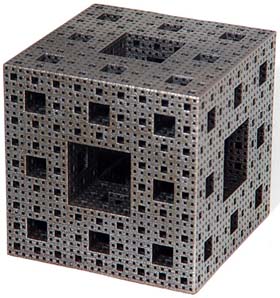
Well, it began a couple of weeks ago, when we spent some time during the March 31st installment of our Super Saturday program working with fractals in the plane. At that time I had a chance to wow the kiddoes with a picture of a Menger sponge, namely this one, a shot of software engineer Jeannine Mosely, standing in front of the sponge she spent nine years building from business cards, with the help of hundreds of folks from around the country. Incidentally, there are 8000 cubes in this one, a "level-3" sponge. (By the way, The hijinx and hilarity continued this week. Just hours ago we wrapped up the today's class, spent assembling a Sierpinski pyramid out of several dozen folded pieces of recycled printer paper, affixed to one another with Scotch tape. [No pictures yet, my camera was at home. Next week! I promise.] The result is quite impressive, and the kids were proud of their achievement. Each took her or his turn holding the behemoth overhead, as though all had played an equal part in its construction. [Truly Jasmine, the lone female in the class whose time, already actively used to its full potential, was freed by not having anyone of her own sex to waste time with, contributed most of the student work on the project. I provided a goodly number of the little pyramids, while Umberto worked slowly yet diligently on his pile of triangles. The few pyramids he made he passed off to Jasmine so that she could skilfully fasten them together. Whether he was motivated by a simple crush or by a sense of pragmatism, recognizing her as the master builder, I'm not sure. In any case, it was cute.] The guts of the Menger sponge that never would be, 200 sheets of recycled printer paper with stenciled cube skeleta photocopied onto them, were left almost untouched. Too bad.) Now, I mean no insult to business cards and recycled printer paper (what better way is there for a piece of printer paper to end its practical life than to be made into a beautiful work of mathematical art?), but it must be admitted that these media are not so sexy as other materials one might choose to build fractals from. Plastic? Wood? Metal? Glass? Ceramic? Silk? The possibilities are endless.
What if, in the spirit of community projects such as Postsecret, people were asked to submit to a central source their own tiny cubes, 2 or 3 centimeters per side, made of whatever material they wished to use and decorated in any fashion desired, and these cubes were assembled lovingly by project coordinators who took care to build the structure by attaching cubes to one another in the manner specified by the contributors: "please ensure that the side bearing my name is not visible..."? Imagine a sponge stretching over 7 feet in any direction, made up of 160,000 (with all due respect, take that, Dr. Mosely!) 3x3x3 cubes of all manner of media, each cube telling a story of an individual contributor, as those submitting cubes could include stories, insights, comments on what the project means to them: "I chose to participate because..."
I'd be curious to see what people would have to say, about the project, about math in general. It's not so often that I get a chance to interact mathematically with people who know so much less about math than I do, with people whose love of math (if it's there at all) is not inherent: how do such people feel about things mathematical?
I don't know.
What do you think of this? Is it a codeine-made pipedream, or a worthwhile artistic undertaking? I'm truly tempted to try this out, but I'm not sure I'd want to start without some backing. Who's got my back? If you're out there reading this, let me know what you think, and ask your friends to check in and let me know what they think, too. Consider it an ad hoc committee on the creation of the Multimedia Menger Sponge Project. Let's get together, people!
Friday, April 13, 2007
Cough cough cough...
Oh my.
I just need a few days off, is all, but when am I going to get them?
As the semester really starts to heat up (don't you love the fast pace of these last few weeks?), I up and decide to come down with the mother of all colds.
To my students: I apologize for the raspiness (and sometimes absence) of my voice, and for any perceived shortness of breath and of temper. If I seem frustrated, it's not with you, it's with my damned lungs. Too, I thank you in advance and retroactively for your patience and understanding, and for your help in ensuring that I only talk when needed, and then only as much as I need to to make my point.
So...what have we got to do to nail things down?
In calculus we'll be finishing up with a little bit more on curve sketching, a treatment of L'Hôpital's Rule, maybe a little Newton's Method. Y'know. Fun stuff. I'll be fitting in one more miniproject, a couple more quizzes, and one more exam, on Chapter 4, before the final wraps things up.
Only a few more days remain in Number Theory and 280; in each, I've got two more days to say my piece before I turn things over to the students. I'm excited about the presentations folks are putting together. In 368 we'll devote whole class periods to the Riemann zeta function and the Riemann hypothesis, to groups of arithmetic functions, to extended properties of Gaussian arithmetic, and to algebraic cryptography. In 280, folks are putting together 15-minute presentations on Ramsey theory, the Fibonacci sequence, Euler's identity, the cardinality of sets of subsets of the naturals, on Pythagorean triples, and so forth. I'm looking forward to it.
Meanwhile, on Sunday I've gotta drive a few hours to the north to James Madison U. to give another talk on detecting hyperbolicity using asymptotic connectivity, assuming I'm well enough.
Oh, the pizza man just drove up outside, I'd best be off for now.
Remind me to post again later on the idea that struck me while lying awake in a codeine-induced stupor last night: The Multimedia Menger Sponge Project. And about another (a 9th! horrors!) student pet peeve I thought of this afternoon. Not to be missed!
Friday, April 06, 2007
Hey, what's it to you?
Math's not for everyone, for sure.
But I get the feeling that more people would be gung-ho about mathematics if they'd not been actively turned off to it somewhere along the road from K to 12.
Last week those cute little kiddies in my Super Saturday program got visibly excited about the L-tiles I had them playing with. They really went to town on those suckers.
I mocked these babies up out of particolored poster board to work on induction with the 280 folks earlier this semester, and I realized then that they'd make a great toy for introducing fractals to the Super Saturday kids. Thus I spent several hours here and there during the past few weeks cutting out a few hundred more tiles, giving myself enough stock to build truly titanic Ls.
And so we did, last Saturday. Five of the seven in the class eagerly worked away, fully cooperating with one another, offering friendly suggestions and pointers, gradually piecing together the L10 monster with 100 tiles in it. (Meanwhile I had to keep the other two from braining each other with a half-empty bottle of Aquafina.) It didn't take long for the sharpest among them to detect the patterns one needed to build larger and larger Ls; if I'd let them, I'll be they would have started work on the L20, though I doubt I had enough Ls to make that one work.
So here's my question: how is it that five bright elementary schoolers were more excited about mathematical discovery than a roomful of math majors? Granted, the stakes are lower in Super Saturday: no assignments, no grades, no deadlines, not to mention the fact that the young 'uns are simply living one of the most carefree periods of their lives. But all that aside, aren't math majors supposed to...oh, how shall I put this?...like math? When faced with designing larger and larger Ls in our 280 class, the reaction from many was disinterested torpor. A few were definitely engaged, but most looked on languidly.
What do we do to these poor kids before they get to college?
We teach them to take tests.
We teach them that math is hard, and only really smart people can do it.
We teach them that "proof" and "poorly-taught high school geometry" are synonymous.
By the time they get to my calc class, I've got to do all I can to convince them that if math isn't fun, then at least maybe it's useful.
Today I found myself explaining to my Calc I kiddies why it is we care about minima and maxima, and like a good little moneymaker, I pulled out the example of a profit curve. A good example, and a sure justification for differential calculus...but why not care about Fermat's Theorem for its own sake? It's a really beautiful theorem, and the road to its discovery is a storied one involving the arduous work of many of history's brightest minds.
I could have said this, yes, but the cold I'm trying to kick has taken the edge off, and I didn't have the energy to fight today what might in most classrooms be an uphill battle. (Would it be so in my classroom?)
Tomorrow morning my Super Saturday kiddies and I are going to work at building a model of the Menger sponge, a "3-d" fractal that we'll put together out of 400 tiny cubes of paper that we'll fold ourselves. You should have seen how stoked these kids were last week when we made that our plan.
Next week, what? Codes 'n' cryptography? More fractals? Who knows.
Next week in 280? Relations. Beautifully flexible, eminently useful: order relations alone make the careers for hundreds of brilliant mathematicians (and in no small measure have contributed to my own).
Why can't they love it as much as I do?
Wednesday, April 04, 2007
From here to there...eventually.
"Coverage" is a four-letter word.
It rankles me more each year.
It's especially frustrating in classes like Calc I, where I've "got to" get to a certain point in the curriculum so that my kiddies won't be left in the dark when a new semester's sun rises on Calc II.
My colleague on the third floor, Fyodor, mentioned in passing this morning that he's happy if his Precalc students end the semester with a basic and lasting understanding of polynomials and rational functions. I concurred.
And I meant every word I said to my Calc class this afternoon in the aftermath of yesterday's exam: "I don't put too much stock in grades." A partial truth. "I'm much more concerned with progress." Closer still to the mark. "If you leave this room with a greater commitment to critical thinking, if you gain facility in performing a few mathematical calculations, if you can grasp the basic concepts behind calculus and how they relate to the 'Big Picture,' then you've succeeded."
Monday, April 02, 2007
Soldier, sailor, tinker, tailor, ploughboy...
Who are you?
Let's say that the instructor waltzes in and announces that you're going to be working in groups. You can't call on your best friend in the class to help you; the instructor's choosing the groups for you, and the way you're all split up appears to be random. Oh great, you're stuck with Jessica. You heard about her. Giselle you don't know, except for the fact that her cell phone's gone off in class three times so far this semester. And then there's Dante. You've never heard him say a word. You're given five minutes at the end of class to meet with your new group members, to get to know each other a little, to exchange contact information. You've got a week and a half to put together the project just assigned, and you want to get to work on it as soon as possible.
As early as your first meeting, two days later, you notice certain interpersonal dynamics. You're focused and on-task (or at least you try to be), while Giselle is not. She gets up every five minutes to get a snack from the vending machine or call her best friend on her cell. Meanwhile Dante has started to work on the project, but he's off in his own world, performing computations that you don't understand and that he seems unwilling to explain to you. That leaves you and Jessica, and you find her to be (quite frankly) dumb as a box o' rocks. Indeed, almost every other sentence out of her mouth is "I don't know."
"Well, did you understand this one?"
"I don't know."
"What did Prof. Buxfizz say about this method?"
"I don't know."
"What in the hell is taking Giselle so long this time?"
"I don't know."
What good could come of working with her? You finally decide to peer over Dante's shoulder as he works away at the project's first problem. At least maybe you can learn a little by looking on.
Do any of these habits sound familiar? Chances are quite good that you've observed one or more of these personalities in group work you've done in class. Maybe you're Dante, maybe you're Giselle. Maybe you're the poor overtasked Jessica, or maybe you really are the monkey in the middle whose role I've given to you as our fictional observer.
Last week my Learning Circle colleague Darlene pointed out that when small groups convene, very predictable personalities manifest themselves. There are type-A leaders who take it upon themselves to see that everything's done right, often dominating the workload and shopping the simpler tasks out to the others. There are the absent slackers, who more often than not don't bother to show up. There are the silent types who are afraid to speak up, fearing they'll betray their ignorance and be laughed at. There are the dittoheads who go along with every answer uncritically, there are the speed-demons who just want to finish everything as quickly as possible, and there are the perfectionists who aren't happy until the seventeenth draft of the group's write-up has at last been produced in the optimal font-size.
What type are you? I've only recently (in the past couple of years) begun to appreciate that successful performance in group work really does require of one an awareness of the sort of persona one tends to take on in group get-togethers. (Likewise, it's not enough for me as a teacher to simply throw the groups together and say, "have at it!") To get a group up and running, you've got to do more than make sure there's a time available for everyone to meet: once all are assembled in one place, there's then the matter of getting everyone to contribute her or his fair measure, to the extent that each is able to contribute according to her or his talents.
What is your talent? What good do you typically contribute to a group endeavor? Can you ask yourself to contribute your share of your positive energy, and can you challenge yourself to minimize your adverse behaviors? Can you bring yourself to contribute something else that's usually left inside of you?
I mentioned in my last post that throughout my schooling I was always the "get it done" guy. I'd rather do all the work myself than let the slower folks in the group take control and botch it up. Of course, having now spent a long time on the "other side of the glass," I realize that this attitude probably rendered all group exercises practically useless for my teammates, but hey: I got what I needed out of it, and everyone got to share in the good grades. Win-win, right?
Now in group work I challenge myself to stay quiet, to not dominate. I contribute, but I wait for contribution from others. I make sure my piece is heard, but I do what I can to incorporate others' views with my own, and whenever I can I paraphrase, reiterate, recount, others' takes on things to make sure that I'm understanding them properly. I offer help when it's needed and do what I can to facilitate the others' learning. If I find myself in danger of dominating the conversation, I try to shut up.
What if you were Jessica? Could you challenge yourself to speak up? This must be hard! Though it's somewhat awkward for me to sit on my hands on not go as quickly as I know I could if working alone, I realize that it must be downright terrifying for a shy and unsure group member to risk the derision of her peers by admitting that she doesn't know what in the hell is going on. Last semester in MATH 365 there was one group in which three of the group's members were decidedly more self-assured than the fourth. This fourth frequently confided to me about how difficult it was to tell his friends to "slow down! I can't understand things as quickly as you all can."
And Giselle, what could she do? Perhaps her challenge at the outset would be simply to stay in the moment and keep her focus. And you, the nameless observer in the comedy above? Could you, perhaps, challenge yourself to be the one to bring the group together? Could you make it your place to call "time out" and reconvene the group to say, "all right, folks, we're just not on the same page on this one. Can we lay out a plan that'll work for everyone?"
I don't know. I don't think there's any one right answer. Every situation is different.
What do you think? I'm really curious to know what's on your mind.
Sunday, April 01, 2007
My 100th post
How 'bout that? It's taken me a while to make that first hundred, as rarely as I've been posting this semester. It's happened that most of the time when I've thought, "huh, that's an interesting thought. I might could write about that," I've ended up being too busy to post it before forgetting about it again. (Me? Busy?)
I've come to realize that for the most part, bloggers are either
1. college freshpeople who have more time on their hands than they know what to do with, writing about why Green Day is the greatest band in history (hint: they're not), or
2. pseudo-intelligent ex-English majors working in the food-service industry, writing about the brilliant conversation on Sartre they shared with the checkout guy at the Piggly Wiggly, and who think that now that they're blogging everyone's gonna find out what sort of genius they possess and that they're sure as hell gonna land that six-figure book advance.
Considering these options, it's probably best that I don't often have time to blog.
Nevertheless, I do corner a few seconds here and there, and sometimes those few seconds come at a time when I happen to be thinking about my teaching, specifically or generally.
Like now.
I just spent an hour or so hanging out in the comments section of one of my favorite blogs (Waiter Rant). Recently he (the anonymous New York-based blogger going by the name "Waiter") devoted a couple of posts to "assholes": one post listed 50 signs that you might be an "asshole customer"; a second, 50 signs that "your server might be an asshole."
This makes me think of an exercise I recently read in Maryellen Weimer's Learner-centered teaching, a work I referenced a few posts back, and which has given me a number of neat ideas to try out in my own classes.
Saith Prof. Weimer: think about starting the semester off with a brainstorming activity in which your students finish open-ended sentences like "I find that I learn well in a classroom where..." or "I find it annoying when the professor...". Let them discuss the matter, arrive at a consensus. This exercise promotes reflection on the learning process and on creating environments conducive to learning, and can serve as a prelude to a "classroom contract" in which the instructor agrees to work to construct an environment where the students' admitted concerns are addressed, and in response, the instructor can offer up a short list of behaviors s/he finds annoying in students and ask that the students do their best to avoid said behaviors.
Both I and my sole colleague in this semester's Learning Circle (shout out, Darlene!) agreed that this activity would probably seem condescending in an upper division class, but it might be a useful one to pull on first-years at the semester's outset.
Why not try it now? I'll share with you a list of my own pedagogical pet peeves, and in response, I hope you can feel free to share yours with me. I'm not claiming that any of my current students are guilty of any particular charge, but you might just recognize yourself in one or two of them. If you do, I hope that you'll do what you can to rein it in. As you'll know if you've been in one of my classes, I'm an easy-going guy, and I'm not likely to tear you a new one if you occasionally step out of line, let your cell phone ring because you sincerely forgot to set it to vibrate, can't seem to stay awake because you were up all night cramming for your Organic midterm, come in unprepared every now and then...I'll let it go, because I know we all have days like that, and I'm not an ogre.
And I like my students. I really like you guys. I have to say that in the almost-decade I've been teaching at the college level, of the roughly 700-800 students I've had in my charge at one time or another, I've personally liked about 99.5% of them. There have been a small few who've rubbed me the wrong way, a couple here and there that've gotten my cheese for one reason or another, but at the end of the day, I can literally count on one hand the number of students I've had whom I just couldn't stand. Really. You wanna know how many? Two. For real. Just two, and neither at UNCA. One at Vanderbilt University (initials RG), and one at the University of Illinois (initials KC). That first was a real piece of work. Remind me to tell you about his golf game up in Kentucky sometime.
If you find yourself identifying with one of the annoyers in the list below, please remember that it's the annoying habit I despise, not the person performing it. Chances are really good that I like you, and I want to continue to work with you as best I can. Just cut the crap, and we'll get along fine.
With no further ado, let me present you with
(I honestly couldn't think of any more. See how easy-going I am?)
1. I'm annoyed by endless complaints about how long it takes one to do one's homework (in my class or someone else's). Complaining about it doesn't finish it, it doesn't make it any easier, and it's not going to earn points from your professor (me included). If I think an extension is warranted (and often one is), I'll figure that out for myself, I don't need your help. Note: freshpeople are most often guilty of this behavior, as they've generally got a pretty poor sense of how much homework is "appropriate." By the way, I'll almost guarantee you that I spend at least twice as much time (often much more) in thinking up, designing, writing, photocopying, posting, grading, commenting on, and returning any single assignment or exam than you do in completing it. (If you ever wanna know how long a particular assignment took me to process, I'd be glad to give you an estimate, it's probably longer than you think.) Please keep that in mind before lodging a complaint.
2. It annoys me when students ask in class about course information that's available on the website. This isn't a big issue, but it's an annoying one nonetheless. I keep a pretty well-stocked website (this too takes a lot of time to maintain properly); if something's not listed/available from the course website, chances are it's not all that important. So if you've missed a couple of days of class and you need to find out what homework was assigned while you were gone, please don't ask me to spend three minutes at the beginning of class tracking that information down for you.
3. In the same vein, if you miss a few class periods, please don't expect me to give you a "synopsis" of the classes you missed. If you had a valid excuse for being gone, I might very well be able to spare 10-15 minutes to brief you on what went down while you were away, but I'm much more likely to actually give you this time if you've taken time beforehand to prepare for this briefing by reading the material we covered in your absence ahead of time.
4. Please don't complain about having to work in a group. I don't care if you don't like to work in groups. You know what? Not all of us do. I include myself in that list. I've always been one of those folks who wants to do everything for himself because he's not quite sure anyone else is going to do it as well as he will. You know what else? At some point in life, you're going to have to work in groups. It's called "committee work," another term for "hell." The experience in group work you gain now, in the relatively low-stakes, comfortable, safe environment of your classroom, the better you'll be at it in the future.
5. I've never been a huge fan of going over homework problems in class if doing so is not an integral part of the course's design (as is the case in my current 280 and 368 courses), especially if the students are not the ones doing the "going over" (see previous parenthetical comment). Some profs like to devote a good chunk of time to going over homework problems, while I, most of the time, don't. Occasionally I'll find it worth the class's while to go over the odd problem, but I'd rather you not ask me at the beginning of every class, "can we go over Problem 346?"
6. In classes where the solutions manual is broadly available, it annoys me to no end when students submit homework which was clearly copied from the manual. The manual can be a useful tool, if used properly, but it's worse than useless if the only purpose it serves for one is as a crib sheet. In the end, it's usually the student's loss, for a few extra points on the homework will be more than counterbalanced by the smack in the face the hapless student'll get come exam time when the solutions manual is unavailable for consultation.
7. Obvious obliviousness on the students' parts annoys me. If you're not gonna mind what I'm sayin' at all, then go home. If you're going to be your group's fifth wheel, go home. If you just can't be bothered to stay awake, go home. If you'd rather sit back and check out the box scores (Spring 2006, Calc II, Section 1?) in the sports section than focus on what the rest of the class is doing, go home.
8. Hateful speech. I hope this goes without saying, but for Pete's sake, people: please don't be crackin' "jokes" or whippin' off "smart" remarks about others' color, gender, ethnicity, nationality, religion, sexual preference, disabilities, intelligence, and so forth, whether it's in general or specific terms. There's really no room for that kind of thing anywhere in this world, and there's sure as heck no room for it in my class.
That's it, for now. Honestly. That's all I can think of off the top of my head. I'm probably in the minority, but little things like inadvertent cell phone rings and discreet lunch-eating don't get to me much. I don't even mind class clowning, if it's not too rambunctious or mean-spirited. It's just the big things, really.
So how 'bout it, Studenten? What professorly habits annoy you? What things have your profs done in the past (no names needed!) that you really could have done without? I'm truly curious.
Are you REUed?
Wow.
In case the news hasn't trickled your way yet, my grant was picked up: this past Monday I learned that UNCA has been awarded an NSF grant to run a Summer Research Experience for Undergraduates program in mathematics.
I'm excited. And terrified.
What this means, of course, is that I will have to forgo sleep for a while. Maybe until August.
In the next month we'll be selecting eight talented undergrads from around the country to take part in an eight-week research program in the fields of group theory, graph theory, and geometry, all writ large. We'll hit everything from network stability to celestial mechanics.
I found out about it last Monday afternoon around 4:30 p.m. I ran home, jubilant. It was Tuesday night that the notion really started to sink in; I think I must have gotten an hour or so of sleep. Between worry over whether or not I'll be able to get everything lined up for the start of the program and these damned seasonal allergies (or is it really a cold?) I couldn't get a wink.
Ah, well.
That's all for now on that matter. I feel like I've got loads to say, but no words to say it with.
Monday, March 26, 2007
Pi Day pix
As promised, here are a few pictures of the Pi Day Festivities at UNCA, held on March 14th on the Main Quad of the UNCA campus. (The event drew over 50 people!) This first is from the very start of the pie-eating contest. We had one poor soul bow out after the first few seconds when it became clear to him that he wasn't going to be in the running. This allowed Nadia (our only female entrant), standing there in the back, to have a seat.
 Here Telemachus and Bocephus go head-to-head a good way through the contest. Bocephus ended up winning the title in the First Annual UNCA Math Department Pie-Eating Contest. Below he displays proudly the leavings of his impromptu meal:
His award? An official UNCA Math Club T-shirt. Hey, I can't neglect mention of the many π fans who showed up at the event. Below Twyla gets into the spirit with a makeshift placard:
The pie-eating contest was followed by the π reciting contest. Ulrich won this handily, belting out 64 places after the decimal in under a minute. Rock! Below he holds his trophy, a mind-boggling wooden math game:
We just gotta do this again next year!