Gentle readers, I have risen from the ashes! Please travel to (and then follow) my reincarnated blog, Changes of Basis, where I will continue to write about all things pedagogical and where I will invite many of my colleagues, students, and community partners to add their voices to my own!
Wednesday, March 23, 2016
Moving right along

Monday, August 25, 2014
Monday, August 18, 2014
Day One...Again...
Though I've been teaching at the college level for 15 years now, I've never been able to shake those first-day jitters. I have, however, gotten better at managing them and overcoming them and even having fun in the process.
This morning I taught my first Calc I class in...three years, I think? I believe this is the longest I've gone without teaching Calc I since I started teaching in grad school 15 years ago. That remove from the Calc I classroom, I believe, will help me come back to the subject with excitement and an authentic sense of novelty. I'm looking forward to a new format (for me), flipping the classroom and using computer-graded problem sets to give students practice in the basic computations they'll need to know.
Today we spent some time getting to know one another and reviewing some of the mathematical ideas leading up to calculus. I ended class by asking the students to write down (anonymously) any questions they might have about our class at this time...or if they had no questions, just to draw a smiley face.
Their questions, and my answers, are below, in no order other than the order I picked them up:
What's your biggest pet-peeve with your students? Disengagement. It really bugs me when students check out. Regardless of your skill level, give it some effort, please: we all have something we can give to the class, and we all have something we can take away.
Could we brush over some of the topics that were written on the board today, because even if I learned them, I need a little bit of remembering? Though we won't do much formal review in this class, we will do a lot of "just-in-time" review, meaning that as needed we'll brush up on important topics (e.g., trig identities, rules for exponents, factoring methods, etc.) when they come up. If you'd like more help, the Math Lab (located on the third floor of Robinson Hall) has many more resources and assistants who can help you, and you can always sign up with a private tutor. (You can find information about tutors from the Math Lab, too.)
I recently purchased a new Chromebook. Do you think all those softwares will be able to get on it? I'm assuming you're referring to Mathematica and LaTeX. I'm not sure about this, but it's a great question. I believe if you run a flavor of Linux as your OS on the Chromebook you should be able to find both of these applications by visiting the websites I've linked to on the class website. If you run the standard Chrome OS, though, I'm not sure. I'll look into this.
If we want to practice/review some old (algebra or similar) concepts, is there a site for problems? Good question. I believe the Math Lab staff can point you in the direction of some good texts and e-resources for review. Visit them!
Are there any other calc tutors other than the Math Lab? You can sign up with a private tutor, a list of whom is available by visiting the Math Lab.
Explain what the "lab" section of the class is. For arcane bureaucratic reasons, the department must differentiate between the "standard" class and the "lab," but besides the difference in time and place, there's no other distinction. We'll do many of the same things on all days. Just show up, relax, and have fun!
Can I eat breakfast in class? Yup. No worries! Just try not to spill anything or eat too loudly.
What is the meaning of life? Dunno. I missed that day.
:)
Q: What is beauty? What is truth? A: Type "graph " into Wolfram Alpha. I'll get on this at once and report back.
Ready for Calc! :)
How many chapters will be covered? We'll discuss the information addressed by the first five chapters of the textbook. I should point out, though, that I despise the term "cover" in reference to education. It corresponds to a very antiquated notion of pedagogy, in which the teacher "covers" material by talking about it in front of the students, thereby absolving the teacher of all guilt in case the students do poorly on an exam. "I can't believe they did so poorly on this question...we covered it in class!"
Is most of the reading done in class or not? Not. You will be responsible for reading the textbook on your own time. I would guess that a somewhat careful reading of most sections should take you about an hour, and we'll discuss roughly two or three sections per week. You do the math!
:-)
Can we review trigonometry? Pre-cal was a long time ago... See my comment above about "just-in-time" review. We'll definitely review trig and other tricky concepts as needed, when needed.
Ready for calc!
It's gonna be a good class, folks.
Wednesday, January 15, 2014
What's a guy to do? (A paean for laziness)
Halfway through our winter break I paused in my course
preparations, panicking that I'd spent nearly all of my time planning my
HON 479 course and had done nearly nothing to prep for Linear Algebra II.
Though I had a rough framework for the course's structure (semiregular
homework assignments, a few take-home exams, student-led projects,
presentations, and discussions), I had almost no idea what content I would include in the course.
After a few moments (okay, maybe a few hours), the panic passed. I realized the futility of overplanning, a futility reconfirmed by the survey of my Linear II students' background I performed on Monday. The 23 students in that class come to me having taken Linear Algebra I from no fewer than five different faculty members in my department, as long ago as two and a half years back. These faculty include me and one of my colleagues who shares my penchant for student-centered, application-based teaching, a couple folks who typically offer a blend of applications and theory (one with a much more student-centered approach than the other), and a fifth who focuses exclusively on abstraction and theory and whose teaching style can only be described as "traditional." Needless to say, my 23 students come to me with extremely diverse linear algebraic backgrounds. It's unlikely that, beyond a few basic principles (row reduction, linear (in)dependence, bases, determinants, eigenvalues and -vectors, etc.) they all will have studied, they'll have any content knowledge in common. In the end there's really very little I can do to accommodate them all: no matter what static plan for the course that I could come up with, it would no doubt lose some and bore most of the others.
This realization was liberating. Instead of putting forth a particular course of study, I could let the students take the lead, offering them the chance to investigate topics in which they are interested, sharing their investigations with each other in the form of in-class presentations, discussions, and problem sets. I'm going to ask every student to take a turn, working with one or two of her or his peers, leading the class in the study of a topic of her or his choosing. For those who might not know what direction they'd like to head in, I made a list of potential topics, many of which likely made an appearance in some students' first-semester Linear I courses:
- orthonormalization methods
- orthogonal systems of polynomials (e.g., Chebyshev polynomials, Hermite polynomials, and Legendre polynomials)
- Gröbner bases
- LU factorization
- abstract vector spaces and modules
- network flow analysis
- unitary and Hermitian matrices and their applications
- finite element methods (e.g., in atmospheric science)
- Google's PageRank algorithm
- the basics of functional analysis
- linear codes and linear cryptography
- applications to differential equations
- linear programming (e.g., the simplex method)
How'll it go? Who knows? Not me. I'm excited to find out, though.
Tuesday, January 14, 2014
Day Two
Two days down. Day Two was a doozy.
The Honors Program has become a victim of its own success, in a way: so many students are now pursuing Distinction as a University Scholar that I'm finding it necessary to offer not one but two sections of HON 479 this term...and perhaps in (nearly?) every term for the indefinite future. Of course, by the time that I realized the need for a second section of the course (about halfway through last semester's advising period), it was really too late to find another instructor to teach that section, and besides, I'd prefer to have a single instructor for both sections, for consistency's sake. Of course, that meant that the instructor for the first section would also be the instructor for the second section, even if it meant (as it did) teaching a course over the normal load. Of course, that instructor is me.
Genius that I am, I scheduled the two sections to meet back-to-back, 100 minutes apiece with only ten minutes in between, every Tuesday and Thursday. Today was our first meeting. By the end of the first section my throat hurt, and by the end of the second I had nearly no voice: there are so many moving parts to this class that I've just got to spend much of the first class meeting pointing out just how all of those parts fit together and more in a meaningful way.
Throw in a minor student medical emergency, a pressing tech issue facing the school's student-run TEDx chapter (for which I'm the faculty adviser), various administrivia and bureaucratic bullshit, and a two-hour sojourn in Asheville Catholic School's gymnasium, where I helped a friend out as a middle-school science fair judge, and you've got a hell of a day. I'm sore-throated and brain-dead, and I'm tired as hell.
But I'm happy. I've got high hopes for this term. I feel like last semester gave me a good grip on 479, and I had a fantastic first meeting of Linear Algebra II yesterday (the 23 students in that class had five different instructors for Linear I!), a course which I'll be teaching from a nearly total project-based perspective.
Life is good.
Tuesday, December 10, 2013
Let it go
It's the last day of final exams, and students are trickling in to say their "farewells" and their "see ya next years." Some are saying yet more long-lasting goodbyes, graduation soon to take them far away.
An hour or so ago three of our more outgoing Honors students came by to bid adieu to Queshia and me. They sat in the Honors office and we talked for about twenty minutes. Much of our conversation centered on the idea of letting go...or not: end-of-semester goodbyes, helicopter parenting, and relationships that have run their course.
"Kids these days," I began, noting that I'd once sworn up and down that I'd never say those words, "don't have the freedom we had when I was young. As long as my parents knew roughly where I was, we were free to roam about the town, with little worry what we'd get into." Now, of course, parents hover overhead. They call the program on their kids' behalves, inquiring about requirements and expectations and perks. They ask after every detail of their kids' academic lives. They have to learn to let go.
We all have to learn to do this, and it's not an easy thing to do.
As I wrote in a recent post, my life lately has been filled with loved ones lost. One of my closest friends lost her mother, suddenly, and not two weeks later another friend, just as suddenly, lost her father. In the skinny interstice between these deaths two other, yet younger, friends of friends passed away, and in the time since my friend's father's death I've heard several talk of losing parents, friends, and pets. It's gotten overwhelming, and, as I hinted in that same post above, I can't say that I've handled it well.
Why not? One reason, I think, is that I've been lucky enough to not have lost many people truly close to me. I've made it through 38 years without losing a particularly close friend or family member. I seem to be blessed with a particularly healthy set of childhood friends, and my friends from college are no less hearty and robust. And my mom and dad both up and moved far, far away from their respective families when they were young, so I grew up hell and gone from my extended families. This meant that I hardly knew any of the grandparents and other more distant relatives I've lost, having only seen them for a few days at a time once every other year or so, and then only when I was very young. We simply weren't close.
I don't mean to sound unfeeling or callous or cold: this is just the way it is. I've never had to deal directly with death; I'm as yet unfamiliar with its effects on me. What's more, I still don't feel as though I'm dealing with it directly, even now, but really only through others, and thus I'm not so much dealing with death as I am dealing with the effects that death has on my relationships with those dealing with death directly. Therefore my experience is a mediated one and, because it centers on others' relationships with me, it's an experience I thought at first was necessarily selfish.
But does it have to be selfish? On reflection, I think not.
When tragedy strikes our friends, we can choose to remove ourselves and feel their pain only through the effects it has on the relationships we share with those friends. We see the tragedy strike, but we don't feel it immediately. We shelter ourselves. We may offer our support, but that support is academic, it's detached and distant.
I fear that this is the kind of support I've been offering to my friends in their recent mourning. I've baked a few dozen cookies and a couple loaves of bread, I've offered the expected words of solace and succor, and I've offered a hand with transportation and child care, if needed. But I've not really been present for the pain. I've spent more time focusing on the way in which the various tragedies affect me, as mediated through my friends' pain in turn.
I need to learn to let go.
I need to learn to let go of my own pain, to feel it, but also to let it pass so that in its place I can place a picture of the pain my friends may be going through as they deal with their loss.
Further, I need to learn to let go of my self, if only for a little while, to see beyond my self and my immediate relationships with my friends, to see instead to my friends' relationships with the loved ones they've lost.
Finally, I need to learn to let go of those very relationships, or at least my static conceptions of those relationships, and to accept that tragedy brings great waves of change and that once those waves have passed the relationships they've left behind might look very different than they did just days before.
To anyone to whom I've not been able to offer the succor or support you've needed from me, I apologize. I've not before dealt with death so directly, and I'm only now learning my own authentic reactions to it. I'm a work in progress, and that progress may be slow at times, but I promise you that it's there.
Thank you for understanding.
Sunday, December 08, 2013
We are family
I'm now three semesters into my stint as Honors Program director, and I think I'm starting to get the hang of the gig. I've learned the ropes well enough to feel confident tweaking things here, cinching it up there, and making many many midcourse adjustments. Give me another term or two and I'm gonna feel ready to make some bigger changes.
Like what? I've had a number of conversations with one of my closest colleagues about ways in which the Honors Program could be made to cater more to students who demonstrate exceptional intellect and motivation via measures other than standardized test scores and high achievement in courses (like AP classes) ultimately driven by rote examination. I don't want to go too far too fast, but my colleague and I brainstormed ways we could modify both the admission process to the program and the requirements for graduation with Distinction as a University Scholar in order to encourage less the grinds, grade-grubbers, and résumé-builders (many of whom either drop from the program before completing Distinction requirements or simply take a path of least resistance, relying on courses they know won't really challenge them) and more the risk-takers, visionaries, and authentic learners (many of whom are ineligible for the program as it's currently constructed because their risk-taking and earnest focus on real learning has led them to lower performance by quantitative measures).
How might we do this? Disallow membership in the program for first-year (or at least first-semester) students, requiring all interested students to opt in to the program (and not simply be placed there) after having spent some time at the university. Admittance criteria would be more holistic and not so focused on classroom performance. The program's curricular offerings would be more intentionally integrative and dovetail with substantial extra- and co-curricular activities and programming. Students would be asked to complete a sort of Honors thesis at the end of their involvement in the program. Most important, Honors students would be asked to interact in a meaningful fashion with students who are not members of the program. Of what this interaction would consist...I don't know. All I know now is that both I and my partner in crime in this revisioning exercise believe that the Honors Program offers a troubling equity issue, providing real resources to the most academically gifted of students, the ones who are less likely to need those resources in order to succeed in their college careers, while their less-academically-gifted peers make do without such assistance.
Excellence without elitism: how do we realize this vision? One way might be to take the tack we've slowly been turning to over the last couple of terms, emphasizing not the Honors Program's academic offerings but instead its sense of community. I truly believe we've done far more to support Honors students' success during the past year through Honors yoga sessions, Reading-Day snacks, "Good Books" reading groups, and Honors trivia nights than we have through sending a small handful of Honors students to statewide, regional, and national conferences.
My university (like every other in the country) is struggling with recruitment and retention, and I truly believe the community-building we're trying to do in the Honors Program is an unbeatable means of achieving those two related goals. Nothing beats the inestimable and intangible benefit of bringing the
students together in the Laurel Forum, introducing those with like
interests and aims, giving them access to one another's support. They'll stick around, and they'll not regret a minute of it. And when their younger peers come to visit the school they'll talk the program up into the stratosphere (I've heard them do it).
So, expect to see more community-building as the program looks to the future. And if you've got any ideas for ways we can do this (jigsaw puzzles? Brew-offs? Iron-Chef-like cooking competitions?), please let me know.
Friday, December 06, 2013
Ubuntu
Yesterday Nelson Mandela died, and the world lost one of its greatest ever agents of peace. Meanwhile, more locally, during the past few weeks several people very close to me have dealt with the deaths of too many loved ones to count: a father, a mother, and so, so many friends (one covered with once-soft black fur). It's been a very rough month, and I don't believe I've handled it as well as I might have. I don't think I've been as present as I could have been; I think I've been too self-absorbed. I've been sleepwalking, but I feel as though I'm coming awake.
Yesterday my HON 479 students put on their long-awaited workshop on
diversity, inclusion, and equity, focusing on the ways in which these
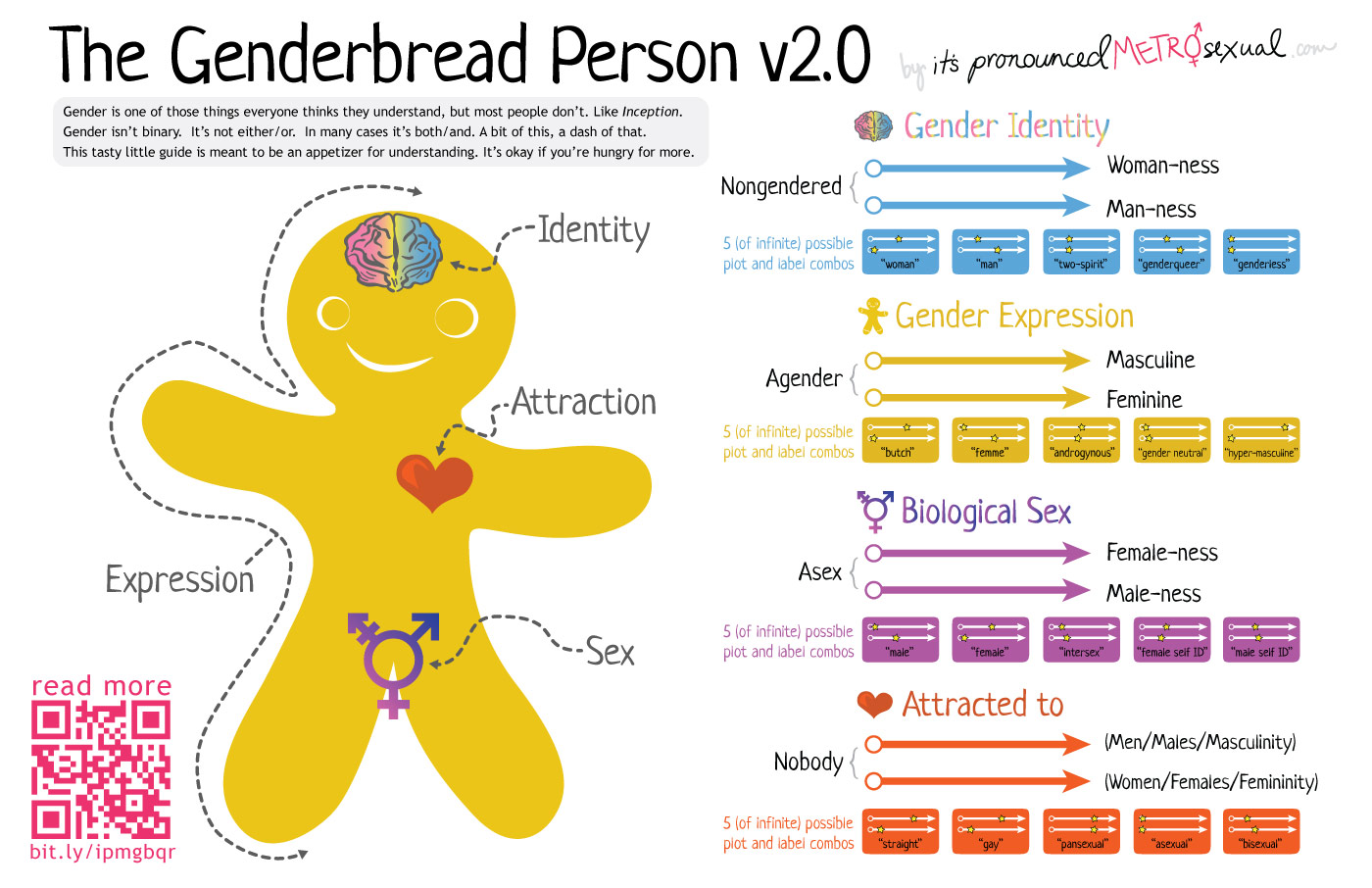
manifest in religion, race, and gender. They worked with a small audience comprising about ten faculty and staff and a couple of their fellow students. The group was small, but it was engaged. The conversations we had were rich, heartfelt, authentic. The event was enlightening, meaningful, and moving. Working with wonderful visuals (Like the Cooper Center's "Racial Dot Map" and It's Pronounced Metrosexual's "Genderbread Person v. 2.0") and excellent activities ("The Cold Wind Blows," religious insensitivity role-plays, and a few rounds of reflective writing on our own gender and racial identities), the students' workshop was substantially better than the awful diversity and inclusion workshop I took part in earlier this year.
At some point late in yesterday's workshop's proceedings, while one of my students was talking about her intellectual journey as a devout Christian completing an academic degree in religious studies, I had a sudden feeling of self-awareness. It was a feeling of being and becoming all at once. It was also a feeling of oneness, of unity with the people I'd just shared the past two hours with. Though our group was small, we represented several races and ethnicities, several religious traditions, several gender and sexual identities. We offered a substantial cross-section of our society, and we were having civil...nay, collegial, even cordial...conversation on some of the most difficult topics for anyone to talk about.
On the way home from campus, NPR told me that Mandela had died, and I teared up in the car. I thought of South Africa's Madiba, and his friends and colleagues in struggle. I thought in particular of Archbishop Desmond Tutu, for whom I have more respect than nearly anyone else. In his incredible book No Future Without Forgiveness Tutu speaks of the concept of ubuntu, a Bantu term referring to our human interconnectedness, which Mandela once described as follows:
"A traveller through a country would stop at a village and he didn't have
to ask for food or for water. Once he stops, the people give him food
and attend him. That is one aspect of Ubuntu, but it will have various
aspects. Ubuntu does not mean that people should not enrich themselves.
The question therefore is: Are you going to do so in order to enable the
community around you to be able to improve?"
In the short time I had before I had to leave again to meet with my writing group I sliced onions for the simple meal of lentils and rice I would make when I came home again, and I read the first lines of the end-of-semester reflection one of my HON 479 students had handed to me just before helping to host that afternoon's workshop. "Dear Patrick, I hope you don't find this format too informal," it begins. "I tailored my response with you in mind, so I thought I might address you directly." In tandem with her humble letter (which brought me to tears by the time I was done reading it) was a hand-made jigsaw puzzle the student had crafted.

I had no time to assemble more than the frame of the puzzle before leaving, but completing the puzzle was the second thing (after starting dinner) I did on my return home.
"You may start to notice (or maybe you have finished) that the puzzle is a tree. I chose a tree because I think it represents various aspects of the IHAD program."

"Now, I'm sorry to deprive you of the satisfaction of putting that last piece in the puzzle, but I did not lose it and neither did you. How frustrating is it to complete a process yet still feel as though you are missing something?...Thank you for going through this puzzling process with me today."
I've recently taken to origami, more seriously than my halfhearted efforts in the past. I am struck in particular by the beauty and meaning of the kusudama, or "medicine ball," a form that's meant to ward off evil and encourage health and strength. I made a kusudama a week ago for a grieving loved one, and I'm making more now, for friends, for family, for people I love. I fear I'll never stop, for right now I feel a sort of universal love which I hope I'll never lose.

It's a new day. As this day begins, please take a moment to love yourself, to love each other, to find peace and joy in all that you do. Enjoy being, but keep becoming.
Wednesday, November 20, 2013
It can happen here...and likely has...
My HON 479 class is wrapping up the semester by considering the phenomenon of urban renewal, an innocuous-sounding phrase the belies its horrific consequences, as detailed in Mindy Thompson Fullilove's book Root shock: How tearing up city neighborhoods hurts America, and what we can do about it.
After realizing that I know next to nothing about how urban renewal affected my own hometown, I resorted to a little online sleuthery and discovered that Helena, Montana was the site of a late '60s/early '70s urban renewal project that fell under LBJ's Model Cities Program. Under Helena's Model Cities renewal, 430 families were displaced from over 200 homes in the South Main area of the city. (These data are drawn from Kennon Baird's website Helena As She Was.)

Considering Helena's population in 1970 was 22,730, we're talking perhaps 7.6% of the city's people removed from their homes. (I've taking an average family size of 4 here; with an average family size of 3 we still have 5.7% displacement.) I've started trying to track down demographic information broken down by race but so far to no avail.
One of my students pulled up the Cooper Center's Racial Dot Map, an excellent data visualization tool that enabled us to see at a glance just how racially segregated most cities in American actually are.
I'm more and more eagerly looking forward to my HON 479 students' workshop on diversity, inclusion, and related topics, coming up in a couple of weeks...
Thursday, October 24, 2013
Being with
I had a hard night last night, and with very little sleep it carried over into an equally-hard morning.
I stumbled onto campus with eyes blurred from lack of sleep and too many tears. After I'd silently taken care of business for a half hour, the Honors Program assistant, Queshia, asked in a very clipped but still-kind tone, "how are you?"
"Not good."
"I can tell."
I pulled it together, and managed to craft what I think is a solid reading response prompt for my 479ers, who are currently reading Robert Moses's Radical equations. I even ended up having a great meeting with the first of my undergraduate research students (progress! Anyone know about the distribution of differences k - l, where kl = a2?). Then I headed off to 479, feeling totally unprepared, a naked charlatan.
I asked the students for updates on their I Have A Dream experiences and visits to HON 179 classes. Oksana spoke to the latter request, talking about her Wednesday visit to my colleague Samuel's 'Sabbath World" class. Samuel is a practitioner (and a very able one) of contemplative practices in pedagogy, and he began the class Oksana attended with a moment of silent meditation, later asking students to reflect on the saying "Remember to stop, to stop remembering." Some students took this as a reminder to pause now and then and reflect on what's going on in our lives, and others as a reminder that we are continually surrounded with our own and others' pasts.
I then took a moment to confess to the students how underprepared I felt, how I had given serious thought to cancelling class, how I didn't feel up to the task of leading discussion. But, I told them, I then told myself that instead of obscuring where I am and what I bring with me, I should come to them unafraid of being who I was in that place and time. "I need to trust in the community that we've built together here," I said, reflecting on hooks. "I need to recognize that being an authentic member of a healthy community often involves, among other things, being honest about who we are and what we bring to each other. I need to let myself be with you all. I need to trust that this is okay."
I was quietly crying by the end, and I thanked my students for giving me a chance to be with them.
I asked if anyone wanted to follow up on this. One student thanked me for my honesty; a second gave me props: "if I were having the day it sounds like you're having, I would have stayed at home and played with my dog for several hours." At this joke the mood grew cheerier, and we talked a bit more about community in general, and the community of the classroom in particular.
At the end, Sallie, whom I've come to know as one of the class's boldest students (despite her calm and quiet voice), got in the last word. "I feel like you're always here for us," she said, "is there anything we can do for you?"
"Besides not make me start crying again?" I joked, fresh tears welling up. "I don't think so," I said, "other than to just be with me today."
We then took a turn toward normalcy, discussing mass-media portrayals of non-white-male figures and challenges to hooks's idea of "radical openness." I settled in. I felt safe. By the end of class, as we concluded our opening discussion of Radical equations, the first minutes of class had been left behind.
My thanks go to my HON 479 students, a community of some of the kindest, smartest, more courageous students I've ever had a chance to work with. I feel blessed to get to learn with you.
P.S. -- it's turned out to be a pretty good day in the end!
Tuesday, October 22, 2013
Build me up
Today the focus in 479 was on bell hook's Teaching Community, the current read. Three students delivered presentations relating the reading to some aspect of their lives; one spoke on the portrayal of American Indians in film and another gave a crash course on feminism while their friend talked about the ways in which community theater can help to build a democratic community. In her follow-up discussion, this last student led the class in a round of communal singing (The Foundations' "Build Me Up, Buttercup"), citing studies showing the sense of community such a simple act can help to build.
Liberal arts education, folks. Isn't it awesome?
One of the HON 179 students visiting the classroom (today was the last class meeting for which I've got such students signed up! sadness...) asked "so, why exactly does bell hooks not capitalize her name?" My students posited several potential answers, most of which came back to one core hypothesis: she's making an intentional move to diminish her authoritarian status. "There are a lot of professors who are really laid back and don't go by 'Dr.' or 'Professor,'" one student remarked.
Yet still there are those who are keenly interested in maintaining a remarkable distance between their students and themselves. I dealt with several such colleagues last week when I took part in a round-table discussion on career opportunities for students in the traditional "humanities" fields. Of the eight panelists, I was the only one from outside of such a field, and four were first- or second-year faculty, fresh out of grad school and a few of them still very clearly vested in making sure their students knew just how smart they (the faculty) are.
After twenty minutes of hearing my colleagues pontificate about how graduate school is the most arduous and intellectually challenging undertaking and how only the most intelligent, the most assiduous, the most dedicated, devoted, and perspicacious survive (the unsaid unsaid: those of us on the panel are not only survivors but thrivers), I had had enough and I finally spoke up. "You know, grad school is hard and it will challenge you," I said, "but honestly I had a ton of fun and enjoyed it immensely. It was a rich time of my life, socially as well as academically. It's not all hard work."
In the end, you have a choice. What'll it be?: build a better community and live in it, or build a taller tower and live above it?
Tuesday, October 15, 2013
479 matters
A question that's been on my mind lately is the following: To what extent do highly idiosyncratic and personal characteristics like charisma, energy, etc. play a role in a teacher's success as a teacher?
This past week I had the dubious distinction of being called to another institution to serve as an external reviewer for a case before that school's post-tenure review committee. Over the course of three days I observed one faculty member's teaching in his several classes and crafted a report detailing his strengths and weaknesses and offering ways he can improve his teaching.
It seems to me that one of the biggest difficulties he was having was in connecting with his students. While to me his concern for his students and their learning is genuine and strong, and while his teaching philosophy is a sound one that's proven effective when implemented well, he struggles to bridge the gap between his students and him. I think that gap is made more wide by the fact that he's simply a naturally quiet person, not prone to public displays of passion.
It's never a bad thing to show passion and excitement for what one does, particularly when one is trying to motivate those who might lack intrinsic motivation for whatever it is they're supposed to be doing...but does this make public and prominent passion a sine qua non of good teaching? I wonder...I'd love to hear folks' take on this.

What else is on my mind?
I've spent some time this semester working on ways to encourage conversation in classes built upon discussion. Given my relative lack of experience in managing such classes, I've asked my students for feedback: what works for them? The other day my HON 479 students hinted (in class and in their reading responses on the nature of a democratic classroom) that they might like to see greater variety in the means we use to structure conversation in class. I therefore put it to them today to offer alternatives to the structure I've used regularly during the semester so far, which generally includes
- a brief opportunity for individual reflection (often driven by low-stakes writing),
- a chance to share ideas in small groups (to offer all a chance to share, and to minimize the difficulty of speaking in front of a large group),
- a brief "reporting out" by sharing ideas on the board and/or by assigning spokespersons to brief the whole class on the small groups' thoughts, all followed by
- a reconvening of the whole class as a plenary body.
As far as I can tell, it worked very well (HON 479 folks, feel free to chime in in the comments if you disagree). We ended up generating a mess of questions we would like to pose to Cornel West when he visits our campus in a few weeks. (He was supposed to visit tomorrow, but his travel's been delayed by a family emergency.)
Namely, when asked what one question the students would ask of Cornel West, I received the following responses:
- Do you believe that our international politics have changed for the better under Obama, aside from the obvious benefits of improving the image of America internationally, as we don't seem like a bunch of hick hillbillies as we looked under the Bush administration?
- Would you prefer to live in another country?
- Is there a way to reduce the hostility surrounding political issues that prevents people from entering into dialogue?
- What role could spirituality play in democracy, if any?
- How can we combat the apathy present in our "democracy"? Is the idea of democracy still relevant when so many people are apathetic or uneducated?
- How do we get (back) to America as a "cultural democracy" then we're so entrenched in the political mechanics of democracy?
- At the end of the first chapter [of Democracy matters], you advocate the need for another democratic awakening. What do you think that should look like for this generation? What do you think are the ideal circumstances to make us stand up?
- Would we know/understand global issues/views if our media did not control the input we receive, assuming the media is controlling? Would we care if we heard/were exposed to the truth?
- How do we move beyond political partisanship and polarization?
- What, in your opinion, is the single biggest, specific, practical way to improve America's democracy?
- How would you explain the political apathy of our (new/upcoming) generation, and how can we begin to combat this suppressing force?
- How can we reasonably overcome the apathy obstructing democracy?
- What can we do to make people feel as though they have the individual power to change things in our society?
- Who do you see as responsible for our current government issues and why?
- [What do you believe] the future of politics is? More parties? Different system? Is any system better?
Whew! The students have enjoyed reading Democracy matters; I only assigned the first chapter, since I was only informed of Cornel West's visit long after the syllabus had been set and the readings chosen. They recommended that it be substituted in for one of the other texts the next time this class is taught, and I believe I'll take them up on that. This makes four texts I'd like to add in, requiring me to take a few out. I'm thinking that next term the following might be the line-up, including three holdovers from this term and four new ones subbed in:
- Kwame Anthony Appiah's Cosmopolitanism
- Michelle Alexander's The new Jim Crow
- Cornel West's Democracy matters
- Paulo Freire's Pedagogy of the oppressed
- Allan G. Johnson's Privilege, power, and difference
- Robert Gottlieb and Anupama Joshi's Food justice
- Mindy Thompson Fullilove's Root shock
Not necessarily in that order. If you have other suggestions, I'd be happy to hear them, in the comments section.
One more question, about which I hope to write in a post of its own soon: to what extent do academics measure professional success by their ability to replicate themselves in their students? Subquestion: is this measure (and the things faculty do to succeed by it) really unhealthy or really fucking unhealthy? Discuss.
Monday, October 07, 2013
Problematizing Honors, or, Thirteen questions
I’m finding it harder and harder to defend what I do. I want to be an agent of change, and not simply a caretaker of the status quo.
What is the Honors Program now? Is it now just a vehicle for perpetuating inequity, reinforcing hegemony, keeping the academic elite (those students who have best learned how to play the “school” game) ensconced in existential safety? Or is it now an opportunity to offer a way out of inequity and hegemony, a place where doctrinaire views can be dissected, interrogated, and challenged?
What can the Honors Program be? How can I do the work to further make it a place where the privileged students who find themselves there encounter a place where their safety and surety, their privileged positions, are challenged?
Is this the best that can come from it? Can it be more still?
While walking together the other day a close friend of mine suggested that I should use my position to dismantle the program from within, to work to replace it with a more equitable support structure, one which offers resources and opportunities to those students who are more marginalized, more vulnerable, less acquainted with the patriarchalist assumptions of a mainstream university education. Such an institution would be something more than a learning resources center, more than an agglomeration of math labs and writing centers. It would be an institution devoted to advocacy for change and not simply to helping students cope with the status quo.
What would I even call such a structure? Where would it be housed? How would the university react to it? What would its charge be? Its day-to-day functions? Is there a precedent for such an entity?
To be continued, no doubt...
Thursday, October 03, 2013
hooks, Ward, and Ladson-Billings

How do you feel about bell hooks's Teaching community?
With hooks's ideas in mind, my students would have made quick work of unspoken assumptions our campus guest Lee Ward (coauthor of First-generation college students: Understanding and improving the experience from recruitment to commencement) made during his presentation to faculty and staff which I attended over lunch just now. "They don't come to us with less cultural capital," he insisted, and I agree, "they just come with different cultural capital." Again, I agree. "No one is deficient in cultural capital." Uh huh. "But they will need our help in developing the capital that will help them to succeed in college."
Okay.
Or...
...maybe we could instead reexamine the hegemonic assumptions (the, as hooks would have it, imperialist white-supremacist nationalist capitalist patriarchal assumptions) we have made that make college such a daunting experience for these folks? Might we try to overcome our institutional inertia, the academic conservatism that keeps us from making a more inclusive, less restrictive and prescriptive, radically open higher educational experience that helps students to feel like they matter by not so explicitly undervaluing the cultural capital they come to us with? For all of its faults (and I think there are a few), I must appreciate Gloria Ladson-Billings's emphasis on culturally-relevant teaching. (See The dreamkeepers, the last book my students read for HON 479. For the record, I don't think there's anything at all wrong with culturally-relevant teaching; I just think that Ladson-Billings tends to mislabel pedagogical practices, calling "culturally-relevant" teaching practices that are simply salutary for other reasons...take inquiry-based learning, for example.)
To be continued, no doubt.
Monday, September 23, 2013
I just flew in from Laredo, and boy...
Highlights from the past week or so (craziness)...
Last Monday through Wednesday I attended the 10th annual fall meeting of the Carolinas Writing Program Administrators at Wildacres. It was my 7th (!) such meeting. I'm getting old. We hosted Doug Hesse, fantastic scholar and teacher of writing and all-around good guy. He led us in a morning of low-stakes reflective writing activities challenging us to rediscover the personal in our professional writing. It was refreshing and calming and fun...fun enough for a few of us (including me) to give up our afternoon speaking slots to free up more time for writing and reflecting.
Who wants to hear me natter on about the effect of LaTeX use on math students' writing rhythms, anyway?
I was then back home (well, in Asheville, anyway) for about 48 hours before leaving town again, but not before helping to host the Honors Program's first world café, an event attended by 66 of our 80 first-year Honors students. Students had conversations about questions we'd designed to elicit thoughtful responses ("What events have shaped your life? Your parents' lives? What events will shape your children's lives?" "What defines community?"). After considering these questions the students were asked to generate questions of their own for other groups to answer...and then we asked them to do it again, leaving each others' company after the final round of student-generated questions were asked.
Late the next morning I left for Texas. I spent a day and a half in Laredo running a workshop on writing in the STEM disciplines at Texas A&M International University (TAMIU). I'd done a similar workshop at TAMIU almost exactly a year before though last year's group was a bunch of middle-school and high-school math educators and this year I worked mostly with TAMIU faculty, with a few Laredo Community College folks thrown in for good measure. I have to say that I'm thoroughly impressed: both workshops were among the most engaged and engaging I've ever led. This last group in particular was stellar, 24 people clearly dedicated to learning more about authentic disciplinary writing. I was particularly excited to speak with Quinaria, a writing instructor who serves the university as one of their first-year experience (FYE) coordinators. Their FYE courses are tied to introductory-level disciplinary courses (like Calc I and General Chemistry), each of which is housed in a designated first-year learning community. There are some course-to-course articulation issues, but it seems like they're dedicated to making their system work. It can't be any crazier than out 179 system.
Back at home for a couple of weeks now. Two weeks from this past Saturday I head up the mountain to Boone for the NC Honors Association conference where my colleague Samuel joins me in speaking about our 179/479 crossover. Samuel and I each have a student presenting, too. I'm excited to see how well my student's talk goes over; Fawn will be speaking about her final project from Oulipo back in the spring, for which she crafted randomly-generated dictionary entries in an effort to satirize the most lofty lexicon ever written. After that it's back to Laredo for a few days, and then to Wilmington for this year's NC English Teachers Association conference...
...always more in store!
Friday, September 13, 2013
Thank you
It's been a good week, and as the week winds down I want to pause, to reflect gratefully.
Thank you, Irene and Iphigenia, the Honors students who volunteered to person the registration table for today's Teaching About India conference, held all day in the Laurel Forum, just next door to my office.
Thank you, Oswaldo, Frederica, Kent, and all my other Linear I students who grapple tirelessly with the crazy conceptual problems I pose them with week after week, patiently accepting my feedback on their imperfect algebra and rambling grammar as they labor to ensure that each draft is better than the last.
Thank you, Lula, my 479 student who spent several minutes this morning talking with me about the problematic nature of the Honors Program: how do we countenance such expenditure of financial and human resources on students who, honestly, don't need the extra assistance to excel while many more of their peers could use all the academic help they can get just to pass? The program is a walking, talking equity issue, a logical extension of the same K-12 "tracking" systems my 479 students just yesterday derided as iniquitous and unfair.
How do I sleep at night? I overcame white guilt years ago; I think I'm still working through my issues with other forms of power and privilege.

Last, but certainly not least, thank you to Queshia, my wise and warm and indefatigable program assistant. Her able handling of administrative nonsense, her unending supply of good ideas, and her tactful dealings with students expressing every need imaginable all make my job a helluva lot easier. I can't imagine a better right-hand person.
Now. Let's make next week a good one too, huh?
Tuesday, September 10, 2013
Shattered mirror
Today's HON 479 discussion was the liveliest yet, with most students having strong, often visibly visceral reactions both to the inequities Kozol describes in The shame of the nation and to the assertion of Allison Benedikt that folks who send their kids to private schools are evil. (In her piece, a soi-disant manifesto, Benedikt offers a rather extremist take on the moral and ethical obligations we have to support our public school systems.)
Time was of the essence. I had a list ten students long of folks who wanted their turn to say a few words, generally in response to one another. "I wanted to echo something so-and-so said..." and "I have to disagree with so-and-so..." were common phrases. A healthy academic conversation is, in part, one in which the students engaged in the conversation respond authentically to each other and not to the perceived authority figure (i.e., the teacher). I could have left the room to no ill effect. Much of what I'd hoped would come up came up, anyway, including connections between not just Kozol and Appiah (cosmopolitan conversations, if only with kids from across town, breed healthy familiarity and better democracy) but also between Appiah and Benedikt (ought to have oughts, but we ought not let our oughts overwhelm our own self-interest).
I also continue to be impressed with the students' civility, respect, and supportiveness. In class today there was disagreement aplenty, but never any friction. The culture of the classroom was friendly enough to encourage a couple of the visiting HON 179 students to chime in with their views as well. These HON 179/479 exchanges are working wonders. The 479 students are enjoying their visits to the various 179 courses, and the 179ers are often contributing meaningfully to the discussions we have in 479.
Meanwhile, I'm looking forward to reading the 479ers' responses to Benedikt. I'll likely ask students for permission to excerpt their work on this blog.
Monday, September 09, 2013
Considering Kozol
On Thursday my HON 479 students began discussing Jonathan Kozol's The Shame of the Nation, a book I first read in conjunction with Kozol's visit to UNC Asheville back in 2006. A scathing indictment of America's apartheid-like public school system, Kozol advocates for dramatic changes in the form, function, and funding of our public schools.
Our discussion on the book was far-reaching and often diffuse, motivated by students' reflection on their own elementary school experiences. With the hope of identifying some more coherent topics for conversation this coming Tuesday, I asked students to submit a topic on which they'd like to see our discussion focus tomorrow. Below are the responses I received.
I would like to talk more about the importance of teaching things in schools that are not as academic and intellectual (art, music, dance, etc.) and why this is important in every school.
whether or not the government is obligated to implement policies that promote equity or just to avoid implementing policies that deter equity.
Who is responsible/accountable for changing and integrating the public school system?
Kozol puts the blame on gov't, teachers and administrators. Are kids/parents to blame?
Ideas on how to fix the problem.
I would like to hear about how racial diversity affects edu.
White privilege.
The issue concerning the national level. What we could do as a whole?
Private funding in rural vs. urban/city areas and how it would/does differentiate
Idea of the tracks that [one of the other students in class] brought up that he [Kozol] hinted at regarding management positions.
The influence of corporate culture on education and what it does to childen
Obviously, the situation for students in these schools is grim, but what about the teachers? Is there anything they can do?
"No Child Left Behind"
school-to-work
The industrialization of schools and schools as job training
What can we (as college students, not as government officials or parents) do to change this for the better?
standardize testing / use of Skinner's theory
Thursday, September 05, 2013
Not a private inquiry
My MATH 365 (Linear Algebra I) course this term has been designated "Inquiry ARC," the "ARC" standing for "Apply, Reflect, Communicate." "Inquiry ARC" is the theme of the university's Quality Enhancement Plan (QEP), a component of our reaffirmation of accreditation through the Southern Association of Colleges and Schools (SACS).
Alphabet soup.
Briefly, every ten years, as a condition of keeping our accreditation, we're asked, as a campus, to formulate a plan for enhancing student learning. This time around we came up with "developing critical thinking," roughly, manifested in the Inquiry ARC program. For the past few semesters we've begun running Inquiry ARC courses, courses which focus intentionally on developing skills relating to one or more steps in the Inquiry ARC process. Last spring, once I knew what I'd be teaching this year, I thought, "what the hell, I'll apply for Inquiry ARC status for Linear I, since the way I teach the course, it's already an Inquiry ARC course." (Not-so-dirty little secret: as any teacher worth her or his salt will tell, you every class should be an Inquiry ARC course...it's just good teaching, folks.)
So far, so good. Communication is always front and center in my courses, given my focus on writing, and I've always been big on reflection. As I've written at length in this blog, I teach this course primarily through applications...and the inquiry? I'm really just going to be able to leave that up to the students.
On Wednesday we spent about 15 minutes on an example I'd meant to take 5, simply because the students kept asking fantastic questions about the example. "What if we changed the number in the last column?" "What would have to happen for us to have a unique solution?" "How does Mathematica know that it's an augmented matrix with three variables and not a matrix with four variables?" and so forth. Not I-have-no-idea-what-I'm-doing-so-I'm-asking-simple-questions-trying-to-get-a-grip-on-this-shit questions, but I've-got-the-basic-operations-down-so-now-I'm-trying-to-take-it-apart-to-see-why-this-shit-works questions. Good stuff!
If they keep it up for the rest of the semester, I'm gonna be a happy man.
Friday, August 30, 2013
Six-word summaries of Appiah's Cosmopolitanism
In class on Thursday I asked my HON 479 students to close with a low-stakes writing exercise in which they summarized Kwame Anthony Appiah's Cosmopolitanism in six words. This exercise is designed to encourage students to get to the meat (or vegetarian meat substitute) of the matter clearly and concisely.
The outcome? The students appear to have learned much from Appiah. They might, however, need help in learning to count.
Respect and do good amidst difference.
Respecting similarities and differences for peaceful coexisting
Understanding different values and being curious.
Global Citizenship requires fundamental change and understanding
Humans can learn from each other.
We can agree if we talk
Learn about others, respect their choices
get a liberal arts education, y'all.
Listen to others, don't be isolated.
Be an accepting, open-minded, thoughtful person/
convivencia, living in harmony as humans
modernity in thought action, no ambivalence
The path to coexistence is conversation.
positivism; cultural identity; imperialism; alternative; curiosity
Try your best to understand each other.
Subscribe to:
Posts (Atom)