So how did I do?
As the semester draws to a close, I'm reflecting back on how well my classes went this term.
Useless, I know: I'm so self-conscious now about asking loaded and essentially pointless questions like "how did I do?", knowing as I do that the best measure of the success of a class is not whether the professor's plans were executed smoothly, not whether her or his lectures were flawless, but rather how much the students were able to learn from the class.
I know this, I know this, I know this. I know that to ask how I "did" as a teacher without knowing precisely how much my students have learned from the class assumes that effective learning is a result of effective professorial procedure, so assessment of that procedure yields an accurate measure of quality of learning.
Yet, as a product of the product-oriented academic establishment that continues to pile everything up into one heap to stamp it with a single letter grade (even while talking from the side of its mouth about portfolios, peer assessment, and learner-centered methodologies), I can't help asking: how well has it "gone"?
I'll soon find out from my end-of-term-evaluations how my students feel, but for the time being I include below some self-evaluation.
Calc I. Overall grade: A-
I feel this class has "gone" quite well. There's some room for improvement, but all in all I can't complain.
I've not taught Calc I for a year and a half now, and after having led four sections of Calc II, one of Calc III, and one of Advanced Calc, all since last teaching Calc I, I wasn't very fresh. I found myself stretching to come up with new ideas for mini-projects (that part went okay, I think), and awkwardly incorporating the team quizzes born in last semester's Linear Algebra class.
What's "gone" well? Class meetings in general have been smooth ones, and I feel that my presentation of the underlying concepts (for what they're worth) has been strong. The smooth flow of class truly has been the work of the students, who've shown nearly no inhibitions when it comes to working together, both in and outside of class. I feel I've developed a good rapport with most of the students, a sort of trust that makes our interactions more fruitful.
What's "gone" not so well? I feel that perhaps I've lingered too long on some topics. I'm not sure I've made as strong an effort as I should have to engage the students outside of the classroom, or to encourage them to do the homework. The "random grading" that I've done for the last four sections of Calc II hasn't gone over so well with the Calc I class, if one is to take any message from the relative infrequency of homework completion. I may rethink this form of assessment before Fall comes. But what will work best to get the students to do the work? Homework quizzes? Grading all of the homework?
Of course, as I've said at length above, it doesn't matter how well I "taught"; ultimately, the question that must be asked is "how well did they learn?" Only the students can answer this question. (Students: thoughts?)
Foundations. Overall grade: B
I started out the semester with exceedingly high hopes, and I'm not altogether certain I've met the goals I'd set out for myself (thus the relatively lackluster grade). I think what's hurt me most is my underestimation of the difficulty of the concepts we've covered: I've forgotten just how difficult it is to master the idea of induction, or how it's far from clear at first what is the structure of a proof by contraposition. I've forgotten that the idea of "relation" isn't immediately intuited, but rather takes time to understand. I've forgotten what it's like to be a budding mathematician, that in the beginning more than at any other time the art takes a great deal of patience and hard work to master, that that mastery comes more easily to some than to others, and that most students will struggle with it. As a consequence, I think I might have assumed that my students are at a higher stage of development as learners than they truly are, opening a chasm between me and my expectations on one side, and them and their abilities on the other. Might this be what's led to the recently-ballyhooed decline in attendance towards the semester's end? (It's hard to stay engaged if your efforts end only in frustration.)
Granted, it was my first time teaching this course at UNCA (and my second time teaching such a course anywhere), so I suppose I'm allowed to err in my assessment of their level of development as learners. I'll know this more well going into the same course next Fall.
Nevertheless, I can think of several students who have excelled as independent learners, who, I feel, have gained immeasurably from the class. I hope they recognize themselves.
To repeat a useless question, for what it's worth: what's "gone" well? The general dynamic of class, with its highly participatory nature, has been a healthy one, by and large. I've had compliments on this dynamic from a number of students who have found it effective, who have said that it makes them feel less anxious about the difficulties in approaching the math, having others to share those difficulties with. Overall, this class, which I've managed in more or less the same way I led Linear Algebra last semester, went far more smoothly than the latter class. (I have a feeling the few students...four, I think...that I've carried over from that class to this one would agree with me.) Students were more engaged in this current class, more eager to contribute, and less trepidatious, and I myself felt more at ease. I felt comfortable with the amount of "lecturing" that I did. I felt this balanced well with the student-centered portions of the class.
What's "gone" not so well? I'm not sure I did as well as I might have in managing the student homework presentations, particularly as regards students' peer evaluation of these presentations. For instance, I didn't challenge the students to challenge each other's solutions, I didn't force them to take the responsibility for the mathematics presented. I think I spent too much time worrying about how long the presentations were taking, and not enough time worrying about how well the students were guiding themselves and each other towards stronger, clearer proofs.
I'm also not sure that I did as well as I should have in demanding boilerplate proofs of everyone. But should I have asked for this?
It's like this: if I've got a student whose grasp of the most basic logical conventions, even at this end of the semester, is, to put it nicely, minimal (and there are a few such students in the class), the last thing I'm going to be worried about in their proofs is whether they ended their sentences with periods. Although good grammar leads automatically to stronger proofs, if the student's handling of the concept "if/then" is nothing more an awkward pawing, no amount of textual emendation short of out-and-out rewriting is going to make a clear proof out of a mish-mash of barely coherent semi-mathematical ramblings.
I'm not sure I'm making any sense.
Again, students: what do you feel?
Number Theory. Overall grade: A
Easy A. With knobs on. I've loved this class, I can't point to a single thing that I feel has gone poorly. The smallness of the class (not to mention the inherent motivation of the students) has led to nearly seamless in-class activities. The students' homework presentations have been strong ones, almost without exception. The worksheets I've constructed based on the text (the first text I've used in years that I feel strongly positively about) did a good job of distilling the essential information into class-long activity guides. The students have cooperated well with each other, have shown genuine interest in the subject, and have unswervingly followed my lead into some pretty dense and detailed detours (like the theory of arithmetic functions and basic analytic number theory). I've already heard from several of the students that they agree with this assessment: they've learned a lot, and they've had fun. This has been one of my favorite classes yet at UNCA.
There you have it. I hope my students will read and feel free to post their own comments (even if anonymously).
Sunday, April 22, 2007
Report card

Wednesday, April 18, 2007
Secret of the pyramids
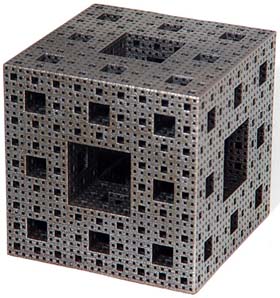
As promised, here's a shot of the fractal the kids and I put together this past Saturday:
Incidentally, while visiting James Madison U. this past Monday I mentioned the Multimedia Menger Sponge Project idea to my colleague Mandi (shout out, Mandi!), whose elementary ed students were busily building Level 2 cubes out of origami paper during my visit. She seemed pretty excited about the idea, as did several of my students whom I polled yesterday.
If I can get enough "backers," I just might start this thing up.
Saturday, April 14, 2007
Number nine...Number nine...Number nine...
Come to class, people. Please?
Look, I understand that "things" come up unexpectedly: illnesses (ohhhhh...do I understand that one well), family emergencies, lottery winnings, superstardom, unexpected tickets to the Superbowl, including all-access passes to get onto the field while Prince is performing...These "things" come up, and they can come as a thief in the night.
Yet these "things" aren't the only things keeping you from coming to class. Other things, less sudden, yet more stealthy, things that don't pounce on you like a jungle cat leaping from the shadows but might rather overcome you slowly, wearing away at you as the semester gets on: excessive love of sleep, excessive love of pot, passive apathy, active antipathy, a malingering defeatist "I'm doing so poorly in this class how can hurt me more if I stop coming" attitude, fin-de-siècle ennui...any one of these things might stalk you quietly and drag you slowly down.
Please don't let these things overtake you, all right?
See, here's the thing: I like it when you come to class. I do. I like seeing you there, I like interacting with you. At the end of the day, I love what I do for a living. While in a particularly peeved mood yesternoon (brought about by, I might add, certain students exhibiting this Ninth Annoying Habit) I was musing to one of my best friends: "why didn't I take a job in industry? I'd be working nine-to-five, making twice what I make now, and I'd have none of the stress, none of the busyness." Of course, the answer came from my own lips not five seconds later: "because I'd hate that. It'd suck, and I'd hate it."
I love my job, every bit of it. I love math, I love math research, and math conferences and math committees...and above all I love teaching math. I love all of these things. I just get annoyed when you don't think it worth your time to come and share my joy. (Oh, and, by the way, your fellow students notice when you're not there, too: when only 15 people of the 23 who are registered for the course show up, your absence is distinctly palpable.)
Again, I'm not talking to those of you for whom "things" have come up. "Things" have been coming up regularly since the dawn of time, and as far as I can tell, "things" will keep coming up regularly for the rest of the foreseeable future. There's no getting around "things," but a quick phone call or e-mail to let me know about them when they do pop up might be nice.
I'm talking to those of you who've decided that it's just too much effort to come to class. Let me end this rant with this note for you.
When you miss class for an inexcusable reason, you send the following message, boldly and clearly, both to me and to your fellow students who do come regularly: "I have very little consideration for the enormous amount of time you spend in crafting learning experiences for me to take part in."
Hey, man, if that's the score, please do me a favor and don't register for the class in the first place.
Whew.
While lying awake a couple of nights ago (I slept well last night, for the first time this week, thank you very much for asking!), my mind addled by codeine-laced cough syrup, I thought deeply of this fractally-formed creature. How came I to these ruminations?
Well, it began a couple of weeks ago, when we spent some time during the March 31st installment of our Super Saturday program working with fractals in the plane. At that time I had a chance to wow the kiddoes with a picture of a Menger sponge, namely this one, a shot of software engineer Jeannine Mosely, standing in front of the sponge she spent nine years building from business cards, with the help of hundreds of folks from around the country. Incidentally, there are 8000 cubes in this one, a "level-3" sponge. (By the way, The hijinx and hilarity continued this week. Just hours ago we wrapped up the today's class, spent assembling a Sierpinski pyramid out of several dozen folded pieces of recycled printer paper, affixed to one another with Scotch tape. [No pictures yet, my camera was at home. Next week! I promise.] The result is quite impressive, and the kids were proud of their achievement. Each took her or his turn holding the behemoth overhead, as though all had played an equal part in its construction. [Truly Jasmine, the lone female in the class whose time, already actively used to its full potential, was freed by not having anyone of her own sex to waste time with, contributed most of the student work on the project. I provided a goodly number of the little pyramids, while Umberto worked slowly yet diligently on his pile of triangles. The few pyramids he made he passed off to Jasmine so that she could skilfully fasten them together. Whether he was motivated by a simple crush or by a sense of pragmatism, recognizing her as the master builder, I'm not sure. In any case, it was cute.] The guts of the Menger sponge that never would be, 200 sheets of recycled printer paper with stenciled cube skeleta photocopied onto them, were left almost untouched. Too bad.) Now, I mean no insult to business cards and recycled printer paper (what better way is there for a piece of printer paper to end its practical life than to be made into a beautiful work of mathematical art?), but it must be admitted that these media are not so sexy as other materials one might choose to build fractals from. Plastic? Wood? Metal? Glass? Ceramic? Silk? The possibilities are endless.
What if, in the spirit of community projects such as Postsecret, people were asked to submit to a central source their own tiny cubes, 2 or 3 centimeters per side, made of whatever material they wished to use and decorated in any fashion desired, and these cubes were assembled lovingly by project coordinators who took care to build the structure by attaching cubes to one another in the manner specified by the contributors: "please ensure that the side bearing my name is not visible..."? Imagine a sponge stretching over 7 feet in any direction, made up of 160,000 (with all due respect, take that, Dr. Mosely!) 3x3x3 cubes of all manner of media, each cube telling a story of an individual contributor, as those submitting cubes could include stories, insights, comments on what the project means to them: "I chose to participate because..."
I'd be curious to see what people would have to say, about the project, about math in general. It's not so often that I get a chance to interact mathematically with people who know so much less about math than I do, with people whose love of math (if it's there at all) is not inherent: how do such people feel about things mathematical?
I don't know.
What do you think of this? Is it a codeine-made pipedream, or a worthwhile artistic undertaking? I'm truly tempted to try this out, but I'm not sure I'd want to start without some backing. Who's got my back? If you're out there reading this, let me know what you think, and ask your friends to check in and let me know what they think, too. Consider it an ad hoc committee on the creation of the Multimedia Menger Sponge Project. Let's get together, people!
Friday, April 13, 2007
Cough cough cough...
Oh my.
I just need a few days off, is all, but when am I going to get them?
As the semester really starts to heat up (don't you love the fast pace of these last few weeks?), I up and decide to come down with the mother of all colds.
To my students: I apologize for the raspiness (and sometimes absence) of my voice, and for any perceived shortness of breath and of temper. If I seem frustrated, it's not with you, it's with my damned lungs. Too, I thank you in advance and retroactively for your patience and understanding, and for your help in ensuring that I only talk when needed, and then only as much as I need to to make my point.
So...what have we got to do to nail things down?
In calculus we'll be finishing up with a little bit more on curve sketching, a treatment of L'Hôpital's Rule, maybe a little Newton's Method. Y'know. Fun stuff. I'll be fitting in one more miniproject, a couple more quizzes, and one more exam, on Chapter 4, before the final wraps things up.
Only a few more days remain in Number Theory and 280; in each, I've got two more days to say my piece before I turn things over to the students. I'm excited about the presentations folks are putting together. In 368 we'll devote whole class periods to the Riemann zeta function and the Riemann hypothesis, to groups of arithmetic functions, to extended properties of Gaussian arithmetic, and to algebraic cryptography. In 280, folks are putting together 15-minute presentations on Ramsey theory, the Fibonacci sequence, Euler's identity, the cardinality of sets of subsets of the naturals, on Pythagorean triples, and so forth. I'm looking forward to it.
Meanwhile, on Sunday I've gotta drive a few hours to the north to James Madison U. to give another talk on detecting hyperbolicity using asymptotic connectivity, assuming I'm well enough.
Oh, the pizza man just drove up outside, I'd best be off for now.
Remind me to post again later on the idea that struck me while lying awake in a codeine-induced stupor last night: The Multimedia Menger Sponge Project. And about another (a 9th! horrors!) student pet peeve I thought of this afternoon. Not to be missed!
Friday, April 06, 2007
Hey, what's it to you?
Math's not for everyone, for sure.
But I get the feeling that more people would be gung-ho about mathematics if they'd not been actively turned off to it somewhere along the road from K to 12.
Last week those cute little kiddies in my Super Saturday program got visibly excited about the L-tiles I had them playing with. They really went to town on those suckers.
I mocked these babies up out of particolored poster board to work on induction with the 280 folks earlier this semester, and I realized then that they'd make a great toy for introducing fractals to the Super Saturday kids. Thus I spent several hours here and there during the past few weeks cutting out a few hundred more tiles, giving myself enough stock to build truly titanic Ls.
And so we did, last Saturday. Five of the seven in the class eagerly worked away, fully cooperating with one another, offering friendly suggestions and pointers, gradually piecing together the L10 monster with 100 tiles in it. (Meanwhile I had to keep the other two from braining each other with a half-empty bottle of Aquafina.) It didn't take long for the sharpest among them to detect the patterns one needed to build larger and larger Ls; if I'd let them, I'll be they would have started work on the L20, though I doubt I had enough Ls to make that one work.
So here's my question: how is it that five bright elementary schoolers were more excited about mathematical discovery than a roomful of math majors? Granted, the stakes are lower in Super Saturday: no assignments, no grades, no deadlines, not to mention the fact that the young 'uns are simply living one of the most carefree periods of their lives. But all that aside, aren't math majors supposed to...oh, how shall I put this?...like math? When faced with designing larger and larger Ls in our 280 class, the reaction from many was disinterested torpor. A few were definitely engaged, but most looked on languidly.
What do we do to these poor kids before they get to college?
We teach them to take tests.
We teach them that math is hard, and only really smart people can do it.
We teach them that "proof" and "poorly-taught high school geometry" are synonymous.
By the time they get to my calc class, I've got to do all I can to convince them that if math isn't fun, then at least maybe it's useful.
Today I found myself explaining to my Calc I kiddies why it is we care about minima and maxima, and like a good little moneymaker, I pulled out the example of a profit curve. A good example, and a sure justification for differential calculus...but why not care about Fermat's Theorem for its own sake? It's a really beautiful theorem, and the road to its discovery is a storied one involving the arduous work of many of history's brightest minds.
I could have said this, yes, but the cold I'm trying to kick has taken the edge off, and I didn't have the energy to fight today what might in most classrooms be an uphill battle. (Would it be so in my classroom?)
Tomorrow morning my Super Saturday kiddies and I are going to work at building a model of the Menger sponge, a "3-d" fractal that we'll put together out of 400 tiny cubes of paper that we'll fold ourselves. You should have seen how stoked these kids were last week when we made that our plan.
Next week, what? Codes 'n' cryptography? More fractals? Who knows.
Next week in 280? Relations. Beautifully flexible, eminently useful: order relations alone make the careers for hundreds of brilliant mathematicians (and in no small measure have contributed to my own).
Why can't they love it as much as I do?
Wednesday, April 04, 2007
From here to there...eventually.
"Coverage" is a four-letter word.
It rankles me more each year.
It's especially frustrating in classes like Calc I, where I've "got to" get to a certain point in the curriculum so that my kiddies won't be left in the dark when a new semester's sun rises on Calc II.
My colleague on the third floor, Fyodor, mentioned in passing this morning that he's happy if his Precalc students end the semester with a basic and lasting understanding of polynomials and rational functions. I concurred.
And I meant every word I said to my Calc class this afternoon in the aftermath of yesterday's exam: "I don't put too much stock in grades." A partial truth. "I'm much more concerned with progress." Closer still to the mark. "If you leave this room with a greater commitment to critical thinking, if you gain facility in performing a few mathematical calculations, if you can grasp the basic concepts behind calculus and how they relate to the 'Big Picture,' then you've succeeded."
Monday, April 02, 2007
Soldier, sailor, tinker, tailor, ploughboy...
Who are you?
Let's say that the instructor waltzes in and announces that you're going to be working in groups. You can't call on your best friend in the class to help you; the instructor's choosing the groups for you, and the way you're all split up appears to be random. Oh great, you're stuck with Jessica. You heard about her. Giselle you don't know, except for the fact that her cell phone's gone off in class three times so far this semester. And then there's Dante. You've never heard him say a word. You're given five minutes at the end of class to meet with your new group members, to get to know each other a little, to exchange contact information. You've got a week and a half to put together the project just assigned, and you want to get to work on it as soon as possible.
As early as your first meeting, two days later, you notice certain interpersonal dynamics. You're focused and on-task (or at least you try to be), while Giselle is not. She gets up every five minutes to get a snack from the vending machine or call her best friend on her cell. Meanwhile Dante has started to work on the project, but he's off in his own world, performing computations that you don't understand and that he seems unwilling to explain to you. That leaves you and Jessica, and you find her to be (quite frankly) dumb as a box o' rocks. Indeed, almost every other sentence out of her mouth is "I don't know."
"Well, did you understand this one?"
"I don't know."
"What did Prof. Buxfizz say about this method?"
"I don't know."
"What in the hell is taking Giselle so long this time?"
"I don't know."
What good could come of working with her? You finally decide to peer over Dante's shoulder as he works away at the project's first problem. At least maybe you can learn a little by looking on.
Do any of these habits sound familiar? Chances are quite good that you've observed one or more of these personalities in group work you've done in class. Maybe you're Dante, maybe you're Giselle. Maybe you're the poor overtasked Jessica, or maybe you really are the monkey in the middle whose role I've given to you as our fictional observer.
Last week my Learning Circle colleague Darlene pointed out that when small groups convene, very predictable personalities manifest themselves. There are type-A leaders who take it upon themselves to see that everything's done right, often dominating the workload and shopping the simpler tasks out to the others. There are the absent slackers, who more often than not don't bother to show up. There are the silent types who are afraid to speak up, fearing they'll betray their ignorance and be laughed at. There are the dittoheads who go along with every answer uncritically, there are the speed-demons who just want to finish everything as quickly as possible, and there are the perfectionists who aren't happy until the seventeenth draft of the group's write-up has at last been produced in the optimal font-size.
What type are you? I've only recently (in the past couple of years) begun to appreciate that successful performance in group work really does require of one an awareness of the sort of persona one tends to take on in group get-togethers. (Likewise, it's not enough for me as a teacher to simply throw the groups together and say, "have at it!") To get a group up and running, you've got to do more than make sure there's a time available for everyone to meet: once all are assembled in one place, there's then the matter of getting everyone to contribute her or his fair measure, to the extent that each is able to contribute according to her or his talents.
What is your talent? What good do you typically contribute to a group endeavor? Can you ask yourself to contribute your share of your positive energy, and can you challenge yourself to minimize your adverse behaviors? Can you bring yourself to contribute something else that's usually left inside of you?
I mentioned in my last post that throughout my schooling I was always the "get it done" guy. I'd rather do all the work myself than let the slower folks in the group take control and botch it up. Of course, having now spent a long time on the "other side of the glass," I realize that this attitude probably rendered all group exercises practically useless for my teammates, but hey: I got what I needed out of it, and everyone got to share in the good grades. Win-win, right?
Now in group work I challenge myself to stay quiet, to not dominate. I contribute, but I wait for contribution from others. I make sure my piece is heard, but I do what I can to incorporate others' views with my own, and whenever I can I paraphrase, reiterate, recount, others' takes on things to make sure that I'm understanding them properly. I offer help when it's needed and do what I can to facilitate the others' learning. If I find myself in danger of dominating the conversation, I try to shut up.
What if you were Jessica? Could you challenge yourself to speak up? This must be hard! Though it's somewhat awkward for me to sit on my hands on not go as quickly as I know I could if working alone, I realize that it must be downright terrifying for a shy and unsure group member to risk the derision of her peers by admitting that she doesn't know what in the hell is going on. Last semester in MATH 365 there was one group in which three of the group's members were decidedly more self-assured than the fourth. This fourth frequently confided to me about how difficult it was to tell his friends to "slow down! I can't understand things as quickly as you all can."
And Giselle, what could she do? Perhaps her challenge at the outset would be simply to stay in the moment and keep her focus. And you, the nameless observer in the comedy above? Could you, perhaps, challenge yourself to be the one to bring the group together? Could you make it your place to call "time out" and reconvene the group to say, "all right, folks, we're just not on the same page on this one. Can we lay out a plan that'll work for everyone?"
I don't know. I don't think there's any one right answer. Every situation is different.
What do you think? I'm really curious to know what's on your mind.
Sunday, April 01, 2007
My 100th post
How 'bout that? It's taken me a while to make that first hundred, as rarely as I've been posting this semester. It's happened that most of the time when I've thought, "huh, that's an interesting thought. I might could write about that," I've ended up being too busy to post it before forgetting about it again. (Me? Busy?)
I've come to realize that for the most part, bloggers are either
1. college freshpeople who have more time on their hands than they know what to do with, writing about why Green Day is the greatest band in history (hint: they're not), or
2. pseudo-intelligent ex-English majors working in the food-service industry, writing about the brilliant conversation on Sartre they shared with the checkout guy at the Piggly Wiggly, and who think that now that they're blogging everyone's gonna find out what sort of genius they possess and that they're sure as hell gonna land that six-figure book advance.
Considering these options, it's probably best that I don't often have time to blog.
Nevertheless, I do corner a few seconds here and there, and sometimes those few seconds come at a time when I happen to be thinking about my teaching, specifically or generally.
Like now.
I just spent an hour or so hanging out in the comments section of one of my favorite blogs (Waiter Rant). Recently he (the anonymous New York-based blogger going by the name "Waiter") devoted a couple of posts to "assholes": one post listed 50 signs that you might be an "asshole customer"; a second, 50 signs that "your server might be an asshole."
This makes me think of an exercise I recently read in Maryellen Weimer's Learner-centered teaching, a work I referenced a few posts back, and which has given me a number of neat ideas to try out in my own classes.
Saith Prof. Weimer: think about starting the semester off with a brainstorming activity in which your students finish open-ended sentences like "I find that I learn well in a classroom where..." or "I find it annoying when the professor...". Let them discuss the matter, arrive at a consensus. This exercise promotes reflection on the learning process and on creating environments conducive to learning, and can serve as a prelude to a "classroom contract" in which the instructor agrees to work to construct an environment where the students' admitted concerns are addressed, and in response, the instructor can offer up a short list of behaviors s/he finds annoying in students and ask that the students do their best to avoid said behaviors.
Both I and my sole colleague in this semester's Learning Circle (shout out, Darlene!) agreed that this activity would probably seem condescending in an upper division class, but it might be a useful one to pull on first-years at the semester's outset.
Why not try it now? I'll share with you a list of my own pedagogical pet peeves, and in response, I hope you can feel free to share yours with me. I'm not claiming that any of my current students are guilty of any particular charge, but you might just recognize yourself in one or two of them. If you do, I hope that you'll do what you can to rein it in. As you'll know if you've been in one of my classes, I'm an easy-going guy, and I'm not likely to tear you a new one if you occasionally step out of line, let your cell phone ring because you sincerely forgot to set it to vibrate, can't seem to stay awake because you were up all night cramming for your Organic midterm, come in unprepared every now and then...I'll let it go, because I know we all have days like that, and I'm not an ogre.
And I like my students. I really like you guys. I have to say that in the almost-decade I've been teaching at the college level, of the roughly 700-800 students I've had in my charge at one time or another, I've personally liked about 99.5% of them. There have been a small few who've rubbed me the wrong way, a couple here and there that've gotten my cheese for one reason or another, but at the end of the day, I can literally count on one hand the number of students I've had whom I just couldn't stand. Really. You wanna know how many? Two. For real. Just two, and neither at UNCA. One at Vanderbilt University (initials RG), and one at the University of Illinois (initials KC). That first was a real piece of work. Remind me to tell you about his golf game up in Kentucky sometime.
If you find yourself identifying with one of the annoyers in the list below, please remember that it's the annoying habit I despise, not the person performing it. Chances are really good that I like you, and I want to continue to work with you as best I can. Just cut the crap, and we'll get along fine.
With no further ado, let me present you with
(I honestly couldn't think of any more. See how easy-going I am?)
1. I'm annoyed by endless complaints about how long it takes one to do one's homework (in my class or someone else's). Complaining about it doesn't finish it, it doesn't make it any easier, and it's not going to earn points from your professor (me included). If I think an extension is warranted (and often one is), I'll figure that out for myself, I don't need your help. Note: freshpeople are most often guilty of this behavior, as they've generally got a pretty poor sense of how much homework is "appropriate." By the way, I'll almost guarantee you that I spend at least twice as much time (often much more) in thinking up, designing, writing, photocopying, posting, grading, commenting on, and returning any single assignment or exam than you do in completing it. (If you ever wanna know how long a particular assignment took me to process, I'd be glad to give you an estimate, it's probably longer than you think.) Please keep that in mind before lodging a complaint.
2. It annoys me when students ask in class about course information that's available on the website. This isn't a big issue, but it's an annoying one nonetheless. I keep a pretty well-stocked website (this too takes a lot of time to maintain properly); if something's not listed/available from the course website, chances are it's not all that important. So if you've missed a couple of days of class and you need to find out what homework was assigned while you were gone, please don't ask me to spend three minutes at the beginning of class tracking that information down for you.
3. In the same vein, if you miss a few class periods, please don't expect me to give you a "synopsis" of the classes you missed. If you had a valid excuse for being gone, I might very well be able to spare 10-15 minutes to brief you on what went down while you were away, but I'm much more likely to actually give you this time if you've taken time beforehand to prepare for this briefing by reading the material we covered in your absence ahead of time.
4. Please don't complain about having to work in a group. I don't care if you don't like to work in groups. You know what? Not all of us do. I include myself in that list. I've always been one of those folks who wants to do everything for himself because he's not quite sure anyone else is going to do it as well as he will. You know what else? At some point in life, you're going to have to work in groups. It's called "committee work," another term for "hell." The experience in group work you gain now, in the relatively low-stakes, comfortable, safe environment of your classroom, the better you'll be at it in the future.
5. I've never been a huge fan of going over homework problems in class if doing so is not an integral part of the course's design (as is the case in my current 280 and 368 courses), especially if the students are not the ones doing the "going over" (see previous parenthetical comment). Some profs like to devote a good chunk of time to going over homework problems, while I, most of the time, don't. Occasionally I'll find it worth the class's while to go over the odd problem, but I'd rather you not ask me at the beginning of every class, "can we go over Problem 346?"
6. In classes where the solutions manual is broadly available, it annoys me to no end when students submit homework which was clearly copied from the manual. The manual can be a useful tool, if used properly, but it's worse than useless if the only purpose it serves for one is as a crib sheet. In the end, it's usually the student's loss, for a few extra points on the homework will be more than counterbalanced by the smack in the face the hapless student'll get come exam time when the solutions manual is unavailable for consultation.
7. Obvious obliviousness on the students' parts annoys me. If you're not gonna mind what I'm sayin' at all, then go home. If you're going to be your group's fifth wheel, go home. If you just can't be bothered to stay awake, go home. If you'd rather sit back and check out the box scores (Spring 2006, Calc II, Section 1?) in the sports section than focus on what the rest of the class is doing, go home.
8. Hateful speech. I hope this goes without saying, but for Pete's sake, people: please don't be crackin' "jokes" or whippin' off "smart" remarks about others' color, gender, ethnicity, nationality, religion, sexual preference, disabilities, intelligence, and so forth, whether it's in general or specific terms. There's really no room for that kind of thing anywhere in this world, and there's sure as heck no room for it in my class.
That's it, for now. Honestly. That's all I can think of off the top of my head. I'm probably in the minority, but little things like inadvertent cell phone rings and discreet lunch-eating don't get to me much. I don't even mind class clowning, if it's not too rambunctious or mean-spirited. It's just the big things, really.
So how 'bout it, Studenten? What professorly habits annoy you? What things have your profs done in the past (no names needed!) that you really could have done without? I'm truly curious.
Are you REUed?
Wow.
In case the news hasn't trickled your way yet, my grant was picked up: this past Monday I learned that UNCA has been awarded an NSF grant to run a Summer Research Experience for Undergraduates program in mathematics.
I'm excited. And terrified.
What this means, of course, is that I will have to forgo sleep for a while. Maybe until August.
In the next month we'll be selecting eight talented undergrads from around the country to take part in an eight-week research program in the fields of group theory, graph theory, and geometry, all writ large. We'll hit everything from network stability to celestial mechanics.
I found out about it last Monday afternoon around 4:30 p.m. I ran home, jubilant. It was Tuesday night that the notion really started to sink in; I think I must have gotten an hour or so of sleep. Between worry over whether or not I'll be able to get everything lined up for the start of the program and these damned seasonal allergies (or is it really a cold?) I couldn't get a wink.
Ah, well.
That's all for now on that matter. I feel like I've got loads to say, but no words to say it with.
Monday, March 26, 2007
Pi Day pix
As promised, here are a few pictures of the Pi Day Festivities at UNCA, held on March 14th on the Main Quad of the UNCA campus. (The event drew over 50 people!) This first is from the very start of the pie-eating contest. We had one poor soul bow out after the first few seconds when it became clear to him that he wasn't going to be in the running. This allowed Nadia (our only female entrant), standing there in the back, to have a seat.
 Here Telemachus and Bocephus go head-to-head a good way through the contest. Bocephus ended up winning the title in the First Annual UNCA Math Department Pie-Eating Contest. Below he displays proudly the leavings of his impromptu meal:
His award? An official UNCA Math Club T-shirt. Hey, I can't neglect mention of the many π fans who showed up at the event. Below Twyla gets into the spirit with a makeshift placard:
The pie-eating contest was followed by the π reciting contest. Ulrich won this handily, belting out 64 places after the decimal in under a minute. Rock! Below he holds his trophy, a mind-boggling wooden math game:
We just gotta do this again next year!
Notes to self
I've given a bit more thought into making a few minor changes in my Calc I course design. Regarding Calc I next semester:
1. Let's think about laying down the law on the first day: what irks you? What irks me? Let's each agree not to do those things, shall we?
2. Let's give that student-weighted grading thingamajig a shot, shall we?
3. Lots and lots o' test corrections!
4. I'm going to mitigate the HW lottery in the following fashion: out of every week's assigned problems, I'll still grade roughly 3-5 of them thoroughly, offering robust feedback and commentary. But...for every problem I don't grade carefully, I'll offer up with a check or an "X." If the checks outnumber the "X"s on the student's assignment for the week, in pop a few more points. This way the students get a few extra points for covering all their homework bases, and they also get a minimum of feedback ("right" or "wrong," essentially) on every problem. Besides, it's something I can feasibly do given the time that I have to grade. It's win-win!
Coming soon: a few pix from the recent Pi Day Extravaganza!
Saturday, March 24, 2007
Running on empty
I have this to say regarding my Number Theory class this semester: it's the first class I've ever taught that I feel is running itself.
I've had low-maintenance classes in the past, and I've had semesters in which I've taught a course I'd taught just the semester before (last Fall's Calc II sections, for instance, saw a repackaging of a large amount of the material I used with last Spring's Calc II folks), but never before have I had a course that just sort of...does it for itself.
That's not to say that I'm not putting any effort into the class (I am), and that's not to say that problems haven't arisen (they have), but the problems have been little ones (like yesterday's goof when I used an inappropriate power for the RSA cryptosystem on the handout I'd written up...oopsies!) and the effort I've expended has paid off to an extent I've never before experienced. I feel that after an hour or so of preparation for the class I can walk in, plop the worksheets in front of the students, and let them take it away. I feel comfortable in that class. I don't worry about it at all, it's very stress-free.
This is largely because of the students in that class. They're strong, they're independent, for the most part they're comfortable working together. Their talent (not to mention Deidre's lightning-fast calculator skills) makes my job an easy one. I'm looking forward to their presentations, beginning in a few weeks. I think Karl is still planning on undertaking a project dealing with the structure of arithmetic functions, and I know Bocephus and Simon are looking into the Riemann Hypothesis and how it related to the distribution of primes. (Simon came to me the other day with a copy of Selberg's paper on the elementary proof of the Prime Number Theorem.) I don't know what some of the others have up their respective sleeves, but I'm betting it'll be good. I'm going to get them to nail down their ideas during the next week.
My Calc I students got my cheese a little bit this weekend, I have to admit. I spent an hour or so this morning grading their latest projects (which were by and large good) and the latest homework assignments. Hmmm...I'm concerned, primarily for those that are clearly not putting effort into the homework. Not surprisingly, those that are turning in the homework regularly (even if they don't complete it so beautifully as they'd like) are the ones at the head of the class. For the most part these are the same folks I see in the Math Lab all of the time (Tiffani, your efforts are paying off!).
Maybe I'm not motivating them properly, not making it clear enough that doing the homework matters? Am I being too nicey-nice, too much of a big softie? The thing is, see, they're just not getting it done. I've never had this much trouble getting a class to just do the homework. I'm not asking for perfection, just completion. I understand that homework is a testing ground, it's where one learns by making a few mistakes here and there. Appropriately, it's low-stakes: any one homework problem counts for so little of the final grade (roughly 0.25% per problem, as opposed to maybe 1.5% or 2% for an exam problem of comparable difficulty, if that's the kind of thing you're worried about) that one shouldn't be concerned about messing up now and then.
Maybe that's the problem, that I'm making it too low-stakes?
Or maybe the "homework lottery" that's worked marvelously for four sections of Calc II during the past two semesters just isn't the thing for Calc I students, or for this particular set of Calc I students?
It's something to think about.
Wednesday, March 21, 2007
Owner/Operators
Monday in class an excellent question came up: someone (I think it was Tomassino) asked if permutations behave like combinations in the following fashion: "is it true that P(n,k) is the same as P(n,n-k)?"
"I don't know," said. "Let's find out. A minute or so later, we'd completed the computations. Of course, it was little more than three or four lines of simple arithmetic, but the lesson learned (I hope!) was more than simply how to manipulate a few factorials. Rather, "I want you all to know that the authority to do mathematics, to ask questions and to solve them, to prove things, to come up with new theorems and new theories, does not inhere in me. It doesn't lie in your textbook, it doesn't lie in the 'experts,' whoever they are. The authority lies in the mathematics itself, and therefore in anyone who takes the time to learn the mathematics. It lies in the logically sound arguments and valid computations of which mathematics is built. Anyone who can learn the rules of logic and algebra and adhere to them correctly and consistently has authority to do mathematics, and so to ask questions, to answer them, to create new mathematical ideas. Anyone. The authority is in you, if you take the time."
As much as I despise the term (primarily for its blatant capitalist and patriarchalist overtones), "ownership of" the material, or better yet, "partnership with," the material, is an end towards which I hope I help my students strive.
The math ain't mine. It ain't the domain of the experts, the pointy-heads, the mathematical gurus that rest on high in chaired positions in Harvard and Berkeley. Hell, it ain't even theirs.
It's everyone's.
Thursday, March 15, 2007
Happy day after Pi Day!
Hey, All!
Yesterday was the 301st Anniversary of the naming of π (celebrated), and the Math Club event I helped to put together went off splendidly. Over 50 people (mostly my Number Theory class combined with Quidnunc's Linear Algebra class, and a few assorted hangers-on) gathered to watch 6 folks compete in the pie-eating contest and 2 in the π-reciting event. Bocephus finished off about 90%-by-volume of his pie in 3 minutes and 14 seconds, giving him the victory in the first activity, and Ulrich recited 64 places after the decimal to garner the win in the second.
Many photos to come soon.
Meanwhile, my classes are chugging along nicely (I don't think anyone was too distraught over classes being cancelled on Friday). In Calculus we're almost done with shortcut rules, in 280 we're set to talk about relations and functions, and in Number Theory we're headed back to the text to talk about more on congruence arithmetic for a little while before tackling a couple of primality testing algorithms. The first of my Senior Seminar students' presentations comes next week, too, as Beulah will speak about hyperbolic geometry and how it inspired M.C. Escher. She's shown me her slides, and she did a great job in putting them together. If she can work out the timing, I think it'll be a fantastic talk.
Now, I've gotta hit the road to Georgia, hoping to make it to Statesboro in time for this afternoon's Project NExT-Southeast events. Tomorrow morning brings our panel on PBL/IBL. I'm looking forward to that, and I hope we get more than the 9 pre-registered participants.
Sunday, March 11, 2007
(Re)start your engines...
All righty, then.
Tomorrow we recommence, revving up for the straightaway dash to the end of the semester.
This is as good a time as any to take stock of where we are in the semester, content-wise. Accordingly, I'm going to ask folks in each of my three classes to spend around half of their respective class periods tomorrow in reviewing what we've done so far: what have we learned? What techniques have we developed? How does it all fit together?
I've been doing a good deal of reading on pedagogy over the break, from the text for this semester's Learning Circle, Maryellen Weimer's Learner-centered teaching: five key changes to practice (Jossey-Bass, San Francisco, 2002), and Alife Kohn's No contest: the case against competition (Houghton-Mifflin Company, Boston, 1986). The latter does not deal strictly with pedagogical theory, but I came to it through Weimer's text, and I've found its insights useful in designing new classroom concepts.
A digest of ideas:
1. "Our classrooms are now rule-bound economies that set the parameters and conditions for virtually everything that happens there" (Weimer, p. 96; emphasis mine). A page later: "our classrooms are now token economies where nobody does anything if there are not some points proffered" (p. 97, again my emphasis). This economic image is an oft-used and apt metaphor for the give-and-take between the student and the professor, and I've come across it in one text after another. Surely some such variety of exchange is inherent in whatever classroom structure one could imagine, but my question is: must the classroom economy always be a capitalist one?
Given the research that Kohn lays out (suggesting that competition in the classroom and elsewhere is generally detrimental to both group and individual achievement), doesn't it make more sense that the classroom economy be one in which cooperative values serve as the "gold standard" for the course's currency? To carry the metaphor one step further, what if we redesign the economy so that it takes on a more "communist" hue?
For instance, I can envision, in a sufficiently small course (no more than, say 7 or 8 students), an untimed, class exam. Either in lieu of or in addition to a stand-alone individual exam, the entire class would be asked to complete a few problems as a unit, the professor sitting by as an observer and as a "clarifier," roles she or he typically already plays in proctoring an ordinary final exam. All students participate in generating solutions, offering ideas, helping to synthesize ideas already put forth. At the outset of the exercise, a single student could be chosen as a scribe in order to create a single solution to the problems presented, and perhaps no solution could be submitted which had not been "ratified" by every person present.
Yes, yes: there are problems with this idea. For instance, there would almost inevitably be "slackers," those who would get the same grade as everyone else without having participated at all, whether out of lack of knowledge or out of shyness. The more outgoing students would also have a tendency to monopolize the discussion.
A compromise between this innovation and the "traditional" exam format might look something like Weimer's study group exams, presented on pages 89-90 of her text. I think Weimer may have turned me off of this idea with her heavy-handed treatment of the "best" students who chose not to participate in the group exam (p. 90).
2. An idea transversing both Chapters 2 and 5 of Weimer ("The balance of power" and "The responsibility for learning") is the following: grant the students the opportunity at the semester's outset to, within reason, decide the distribution of point values for various types of assignments. This student-led distribution could occur on the first day of class, students breaking into small groups to meet one another and discuss the pros and cons of weighting this sort of assignment that much, and so forth. After giving each small group the change to come up with some rough guidelines, the class could be reconvened as a whole, and ideas shared. A consensus can then be approached: how much will this be worth? Once point values are arrived at, we'd record the result and all stick to the deal.
Obviously there should be some initial parameters outside of which the students would not be allowed to deviate. For instance, in Calc I class, I would ask that each of homework, quizzes, projects, and exams count for some percentage of the class's points, and I would likely set some minimum values (HW must be worth at least 10%, quizzes at least 10%, and so forth). But from there, the students would be on their own. I'd even let them throw in extra requirements, like attendance, if they saw fit to include them.
This arrangement has the benefit of providing students a chance to take control of the grading system to some extent, and thus while it gives them greater power (and less excuse for complaining should they not keep up!), it also invests them with commensurate responsibility.
3. Through Kohn's text I've found some interesting tidbits on pedagogical competition, from other sources: Morton Deutsch, in Education and distributive justice: a social-psychological perspective, Yale University Press, New Haven, 1985, writes: "If educational measurement is not mainly in the form of a contest, why are students often asked to reveal their knowledge and skills in carefully regulated test situations designed to be as uniform as possible in time, atmosphere and conditions for all students?" (p. 394, from Note 48, Chapter 2 of Kohn). Good question. As a fairly non-competitive soul myself, I hate in-class exams and see little purpose to them in the long run. It was this line, in part, that made me think up the class exam scheme in (2) above.
Also, Kohn says on one of the works of the brothers David and Roger Johnson ("The socialization and achievement crisis: are cooperative learning experiences the solution?," Applied Social Psychology Annual 4, L. Bickman ed., Sage, Beverly Hills, 1983): "In fact, even the widely held assumption that 'students learn more or better in homogeneous groups...is simply not true.' A review of hundreds of studies fails to support this assumption even with respect to higher-level students" (Note 28, Chapter 3 of Kohn). There's some ammo for the folks who take flak for "making the smart students work with the dumber ones."
All in all, I'm enjoying both books. Weimer, though I'm not always agreeing with her and I find her tone a bit condescending at times, has given me a good deal of practical ideas, while Kohn's work has been a great fount of references to other authors who purport to prove claims I've heard bandied about before but have never been able to track to the source.
Monday, March 05, 2007
Spring Break!
Well. Yeah.
Here we are.
Here in the South (where they wouldn't know real winter weather if it smacked 'em upside the head with a two-foot blizzard and subzero wind chill) it snowed yesterday, and though there are two weeks left before spring actually begins, we're on Spring Break.
For me this means it's a good chance to get ahead in class prep, since March and April are going to be busy travel months for me (two conferences, two colloquia on the schedule so far), and I'm not going to want to fall behind while gallivanting about the eastern United States. It's also a good chance for me to post here for the first time in a looooooong time...
The funny thing is, I'm less busy this semester than I was last semester, despite the fact that I'm doing three preps this time around (and for the first time ever). Most of the slack is due to the fact that 365 is not one of the classes I'm teaching...I put so much of myself into that course, and I let so much of myself (including sense of self-worth, I fear I must say) get wrapped up in how well I pulled it off. Even when I was done getting ready for 365, I was never done worrying about it.
I have to say that I'm enjoying this semester a lot more than I did the last, perhaps to a large extent because I've managed to distance myself personally from my classes. That's not to say I'm not being myself in class, as I am, and it's not to say I don't care about the students, their learning, or their welfare. I mean only that I recognize that the success or failure of the class, however that might be measured from day to day and week to week, reflects in no way on me as a person.
And the funny thing is, I think I'm doing a much better job with both of my upper division classes this semester than I did with 365 in the fall. Things are running a bit more smoothly. I've found in both 280 and 368 a good balance between me standing at the front and yammering like a talking head and the students working the entirety of the class period with minimal direction from me.
368 is purring along particularly nicely. The text is fantastic, and eminently suitable for the manner in which I'm teaching the course. I've found that by distilling each chapter into a short worksheet I can ask the students to do most of the computations and the bulk of the simpler proofs, leaving me to stand off to the side to lend a hand on the trickier arguments as they arise. The presentations are rotating nicely in that class, and I've had no trouble convincing people to volunteer to present. Right now we're off-text, working our way through a couple of weeks of analytic number theory. We spent the last week on divisor sums and Dirichlet convolution, and the coming week brings an estimate of the average number of divisors for large numbers (a value that tends to ln(x) in the limit). After that we'll return to the text to do a little cryptography before heading off towards elliptic curves and more about Fermat's Last Theorem.
280's easin' on down the road, too. Freeing myself from a text was the right thing to do for this class, I believe. Though it's meant that I don't have a ready reference immediately at hand, it's also meant that I can run the course using the in-class worksheets without having to defer to a text that covers topics in just such an order, that provides at-best weak explanations or overly difficult exercises. I'm happy with the day-to-day goings-on, though people aren't nearly as eager to present HW solutions as the 368 students are. (I'm chalking that up to the relative mathematical inexperience of the 280 crowd; it's nothing unexpected, nor is it to be sorely lamented.) I'm very pleased with the improvement I'm seeing in a lot of the students' work. I'm thinking particularly of folks like Neville, Sylvester, and Una, a trio whose first homeworks were lackluster, but in whom there was definitely potential. In the past few assignments from them, I've seen much stronger structure, clearer arguments, cleaner logic, better use of notation. All three of them have put in long hours in the Math Lab, and it shows. Kudos! Of course, I'm getting stellar performance from people like Fiona and Elmer, folks I knew I could count on to do well. From everyone, there are struggles to be won, but I think overall we're at a good place to be by midsemester. Right now the order of business is combinatorics: combinations and permutation rule the day, and by the end of next week we should begin talking about functions and relations.
Oh, yeah, and the University's Writing Intensive Committee has ruled: 280 is now officially a WI course, from here on in!
Finally, I'd be remiss if I left unmentioned my Calc I class. They're a laid-back bunch, and after 280 and 368, which are often hectic and fast-paced, it's often nice to wind down the day with the 191 folks. We're moving a bit more slowly than I typically do, but I truly think it's the right thing to do. There are a number of people in this class who haven't had math for quite a while, who aren't so confident of their math skills as they might could be, and the slower pace is letting them absorb the material more meaningfully than if we were simply blazing through it. We're just now working our way through the Product and Quotient Rules, and by next week's end should be ready to consider some interesting applications.
So that's the score.
Big-picture-wise, I'm still waiting to find out whether or not I'll be getting this REU picked up for the coming summer...the fact that I've not yet heard could be a good thing. Ever the optimist am I. If we don't land that big fish, I'm going to try to rustle up a couple of research assistants for the summer so's I can have a crack at a couple of problems from geometric group theory I've had on the back burner for several months.
Thursday, February 08, 2007
It's been a long time...
...since I rapped at y'all. What's up?
We've been chugging away in all three classes, and things are running well all around. The folks who spent last semester with me in Linear who stuck things out to find themselves in 280 agreed with me when I mentioned it yesterday before class: 280's going a lot more smoothly than did 365.
This is large due, I think, to the fact that I've discovered the means of class preparation that works best for me: engage in thorough medium-range planning, punctilious day-to-day planning, and don't sweat the long term. I think mapping out 365 in advance was ultimately a mistake, as it created the illusion of an artificial schedule, a framework which didn't really exist. It existed on paper because it was "supposed" to exist there, but I never really brought it to the classroom.
This semester, both 280 and 365 are being constructed more or less one week at a time, and hours of careful planning goes into each worksheet and homework set, but I'm not worrying about where we'll be in six, seven, eight weeks. I suspect we'll finish the first 20 or so chapters of Silverman in 368, before veering off into primality testing and Fermat's Last Theorem in the context of Gaussian integers...I suspect that after proof methods and propositional logic I'll lead the 280 folks into the wonderful world of axiomatic set theory, and then do some theory of relations...I suspect these things, but I'm hardly going to commit them to paper until we get there. Trust, though, that once we get there, the treatment will be careful, meticulously crafted, and exact.
So what are we doing just now?
This week's Induction Week in 280, and yesterday's struggles reminded me how hard it is for even the most intelligent student to grasp induction when it's first introduced. (To say nothing about the difference between limits and indices in sigma notation...) We'll do a few more examples tomorrow, introduce Strong Induction, and use it to prove the well-orderability of the naturals.
In 368 we're doing congruence computations left and right. Fermat's Little Theorem is our main course tomorrow, when we'll learn how to find the last digit in 4200018 without a calculator.
In Calc I? We're getting nitty-gritty tomorrow with the epsilon/delta definition of a limit. Since they've already seen and drawn a good number of "banded graphs," I'm hoping it's not going to be too much of a stretch.
But it always is.
Anyhow, that's where we are right now. Humdrum, ho dee hum.
Wednesday, January 31, 2007
Playin' the fool
Consarn it...
Lorelei came to 280 a bit before class began and found herself a seat in the back where she could sit and observe, herself unobserved. Towards the end of last week she'd checked with me to make sure she could sit in and look in on class for one of her psych classes. "Sure, I said."
Today, I began by returning homework from this past week. I'm so used to her presence in my classes that my initial thought was "Oh, Lorelei's not handed anything in...that's not like her." I went back to her seat and said, "Um...I don't think I got yours. Did you hand it in under my door?"
"Are you serious?"
"Yeah, I don't have it here."
"No really, are you kidding?"
"No."
"Umm...I'm not in your class."
The clouds parted. I bashed Lorelei repeatedly with my class notes.
Much hilarity...must go to Number Theory.
Back in the saddle again
Yesterday was my first day teaching in almost a week, what with last week's abridged schedule precipitated by my travel to give a talk in Denver, and this week's late start brought about by a few flakes of Sunday evening snow.
So Tuesday it was, a roomful of semi-sleepy Calculus kiddoes. We're almost done with Chapter 1, and we'll soon blister our way through Chapter 2, limits 'n' continuity.
Ah, limits, how I've missed ye!
Today looks to be a full day: we begin proofs proper in 280, and we'll solve some linear equations in Number Theory. More o' the same for Calc, with a refresher on inverse trig functions. Joy.
I'm finding it hard to get motivated today, who knows why?
A bit tired, I suppose.
Too bad I've got no cheese to go with this whine.
Wednesday, January 24, 2007
No time to write, but...
I just wanted to let y'all out there in the world at large know that...
1. 280 went well, with two solid demonstrations to inaugurate our student presentations. We followed that up with a discussion of compound statements, in which everyone played an active role. Although I'd take last Friday over today, I'd take today over Monday.
2. 368 was a good ol' time today. Our first student presentations went splendidly there. Oswald and Bertrand showed us a neat fact involving primitive Pythagorean triples in which the "odd shorter leg" is divisible by 5. Leonardo and Egbert had a quicker proof to give, and managed it handily. We continued by talking over Euclid's Algorithm for GCDs.
3. We had our first group quiz in 191 today, and people worked together on it WONDERUFLLY. I'm very happy with y'all! And...
4. ...I heard just hours ago that Fall 2006's MATH 365 is now officially Information Literacy Intensive! You may commence rejoicing. And yes, Fiona was the first person I told.
Tuesday, January 23, 2007
Monday, Monday
Meh.
Yesterday felt a little...off. Not that any class went particularly poorly, but I don't feel that any of them "zinged" either.
In 280 we put a stopper in negation, spending the hour negating all sorts of statements with quantifiers. I think order of quantifiers and scope of variables is still confusing to enough people that I spent an hour or so last night and wrote up a handout with 17 more examples of quantifier statements, organized by "Statement/Negation/Reordered quantifiers." I hope that'll help folks to get a better handle on such statements as we go into tomorrow's class on compound statements. We start things off with presentations of the solutions to two of the first set of homework problems.
In 368 yesterday we pounded away at Pythagorean triples. It took us about 30 minutes to prove the characterization of all primitive integral triples. There was call to use our characterization to come up with a massive primitive triple, so we took s = 625 and t = 729 and generated
just to look at it. They're working on a different Diophantine equation for next week's homework. Tomorrow will start off with presentations on the second homework set, and we'll go from there to work on basic divisibility.
In Calc I we finished up with exponential functions and various perturbations thereof that can be used as more realistic population models. After working with Mathematica on the logistic equation, several of the students expressed interest in obtaining the free version of the software they've got coming to them under our site license. Score.
Today's a bit laid back, I've got a few student meetings and some prep work to do, but nothing crushing...there is an all-campus faculty/staff meeting in a few hours, but nothing else to keep me away from the office until class. Calc I today: shiftin' and scalin' and other nonsense with functions.
Friday, January 19, 2007
Oh yeah...
Hello, all!
Second day of class for a couple of my classes, I've finished 280 and Number Theory today. Lemme tell ya, 280 went awesomely. I had a good ol' time. I mean, how hard is it to have fun when you're making up crazily false mathematical statements?
In all earnestness, I did have a lot of fun in class today, and I think we were right where we need to be, all over mathematical statements and their truth, quantifiers singly and in conjunction with one another. There was willing, active participation, there was effective group communication, there were apt, authentic, and clever examples galore (my, do I have some smart students!). There were laughs, and no tears. There was excitement. I'd be a happy man if every class I lead were to come off as well as this one did.
368 went well, too. 45 minutes of the class were spent by the students giving their presentations on the first chapter of Silverman. We had some very robust discussions on twin primes, Dirichlet's theorem and its consequences, primes of specific forms, proofs of the infinitude of primes, factorizations...we were deep enough into the discussion that we only just had enough time to spit out a few small facts about Pythagorean triples (Silverman, Chapter 2) before calling it a day.
Hijinx and hilarity outside of class, too: Karl and I spent a half hour before class looking at connections between triangle-square numbers and Pell equations, examining the limiting behavior of a curve whose infinitely many integer-valued loci give rise to triangle-square numbers.
I love these students! I'm feeling like the luckiest teacher in the world today.
Wednesday next is the first day of presentations in both classes, and I'll be fishin' for volunteers come Monday. I'm pretty sure I'll find no shortage of willing confederates: both classes are stocked with solid students chocked full of mathematical derring-do.
Now, off to Calc I in the few minutes. Dare I ask for a third wonderful class?
Wednesday, January 17, 2007
...And the hilarity continues!
368 went off pretty well. It turns out we'll have a 13th member of the class who hasn't registered yet, but who will be signing on soon. The more, the merrier, but unfortunately 13 is has a much smaller number of divisors than does 12 (in fact, here's a note to 368 students: 12 is actually abundant. What does this mean?), a fact which makes 12 a class size much more amenable to fair and equitable group work. Nevertheless, we'll prevail!
We spent most of the class period today just jawing about various sorts of numbers, focusing on prime numbers and their importance in the realm of cryptography. The difficulty of factorization came up in our conversation, as did the AKS algorithm for primality testing, theoretical considerations involved in counting primes without explicit testing, and subtleties dealing with the Prime Number Theorem. Karl (continuing in the use of pseudonyms) asked a fantastic question regarding the estimate provided by the function x/ln(x), as to whether one could tell if it were an underestimate or an overestimate. We wrapped up by checking the accuracy of this approximation for 1016 and 1021, and neither gave substantial error (Deidre, I fear you might have made a calculator error in class...). Cool beans. We'll start off class on Friday with brief presentations on different sorts of natural numbers, and questions that can be asked about them.
Meanwhile, in my one section of Calc I, I had a great time today. The first 15 minutes or so were ho-hum as I was busy yammering away about functions and how they're defined, but once I turned the class over to them, I had a lot more fun. We spent 15 minutes or so coming up with and graphing some real-valued functions, breaking out Mathematica for the first of what will be many times this semester. Afterward, I let them take a crack at designing plausible functions to describe several phenomena occurring in geoscience, chemistry, physics, and the humanities. (As always, you can check out the prompts for this exercise on my website.) Boy, who'da thought that you could get folks in a Calc I course to come to fisticuffs over a hypothetical reader's interest in Northanger Abbey?
Ah, and soon Friday comes...
First Day, take 2
Yesterday didn't count, did it?
I mean, I only had one class.
I'm not sure why we bothered to start on a Tuesday. Weird.
Ah, c'est la vie.
We'll call today the first day of class, though, okay?
I've just wrapped up our first meeting of 280, our intro to proofs and other foundational aspects of mathematics. It went pretty well. It's at the perfect time of day, after the early-morning sleepiness has passed and before the lunchtime restlessness sets in. As a consequence, everyone (your humble narrator included) was bright-eyed and bushy-tailed, awake and up to the challenge. We had a good ol' time building a theorem from scratch, and proving it. Based only on data suggesting that ODD + ODD = EVEN and so forth, we came up with a clean statement of the appropriate theorem, and we managed to prove one of its three prongs before the metaphorical bell rang. On deck for Friday: fun with quantifiers! Oh boy!
In half an hour my number theory folks meet for the first time. I'm looking forward to that one with eager anticipation. I had two more students enrol just this morning; it's a good thing I checked my rolls before heading over, I was able to print off a few more copies of everything.
Before I leave, here's a shout out to Nikola, up in Maine! Nope, no 0-degree weather here, sadly. I miss the cold. I did, however, and much to the surprise of some of my students, wear shoes to walk across the quad this morning.
Tuesday, January 16, 2007
...We're off!
First day of class!
Sadly, I got very little sleep last night, and so at this point I am pretty much dead on my feet.
A light day to open things up this semester, only one class to teach. (I have been here since 7:30 this morning, though, putting together activities for the remainder of the week.) My first installment of Calc I went well enough. Our "average-velocity-becomes-instantaneous-velocity" exercise came off okay, but didn't spur huge involvement. This class seems a quiet bunch for the most part, unless everyone was simply as tired as I am. I fear I might have to wake some folks up a bit with more interactive exercises. Don't think I won't do just that!
I apologize for incoherence...I'm just about ready to fall asleep on my djfffir46o-3gfklb...
Monday, January 15, 2007
Aaaaaaaaand...
I spent a few hours in the office this morning putting the finishing touches on the first-day activities for my three classes.
Three! This'll be my first semester with three preps. Wow. Zowie. Havah nagilah!
Fortunately, I've taught two of the classes before. One of them often enough that should I be called upon to do so, I could teach it with my eyes closed. (Fear not, gentle Calculus I folk, I shall not attempt this feat, nor shall I give you any less than a full measure of my preparations and attention!)
At this point, everything's printed up (save the handout for 368; the copier ran out of toner at the last minute) and posted on-line. I invite you to check it all out on the respective websites.
One nice thing about this semester is the relatively small number of students I'll be working with. After working with over 100 students last semester in one way or another, I'll be dealing with about 60 this time around, with 18 registered right now for my Calc II class, 24 in 280, 10 in Number Theory, and 3 for MATH 480, with a single undergraduate researcher dolloped on top. Even if I see a mad rush of calcfolk charging into my little afternoon calc hidey-hole in the next couple of days, I shouldn't have more than 60-65 people to deal with. And I know almost half of them already. Of my 24 MATH 280 students, f'rinstance, I've met 15 of them, and 13 of these people I've had in previous classes. (Some of them in as many as FOUR classes...you know who you are!)
As regular readers will note, this semester's starting up with a lot less fanfare and foofaraw on my part, and that's probably a good thing. I don't plan to undertake any major renovations in my courses this semester, though there'll definitely be some tweaking here and there. I'll let those tweaks and squeaks speak for themselves, though, rather than advertise them in bold 'n' brassy "hello world!" internet announcements.
It's getting rather dark outside, I hope this doesn't presage some sort of ominous goings-on tomorrow.
Better check the weather forecasts...
Saturday, January 13, 2007
Primathlons and proofs
Work continues apace! I've managed to get all of the syllabi for this semester posted (280's can be found here, and 368's here.) In addition, I've got the first day's activities for 280 written up and ready to run, I'll get those posted soon.
I've got in touch with Deadrick, Nikola's colleague up in Maine who's just started teaching number theory for the first time up there in the Moose-covered hinterlands. Strangely enough, he's using the same book that I am, too! We're going to take this chance to keep in touch and compare notes as we proceed. I hope he'll take the opportunity to read along and post his thoughts during the semester.
The funnest aspect of 368 might be the Primathlon, a semester-long prime-finding event I'm sponsoring for the 368 folks in order to give them ample opportunities to earn extra credit. The deal: throughout the semester, they'll be allowed to submit proofs of primality to me (which proofs must consist of personal verification by algorithmic or theoretical means that the purported primes truly are prime). For such proofs they will earn extra credit, depending on how big are the prime numbers they find: for finding a prime with at least 10^k digits, they will earn k percentage points of extra credit in the class. Judging from the length of time it took my fairly sophisticated (relative to an introductory number theory course) strong pseudoprime primality test (with a handmade modular power function), run on Mathematica, to verify the primality of a 3000ish-digit primorial prime, I have a feeling I'm not going to be handing out extra credit like candy.
We'll see, though. I know most of the folks in that class already, and there are some pretty hardcore math majors among them!
Things get underway on Tuesday with Day One of Calculus I. I've got a dynamic exercise I'm going to use to make that first loooooooooooong class pass reasonably quickly. I've got a little bit of prep to do in all three classes before then, but I'm mostly there.
More later!
Tuesday, January 09, 2007
Nawlins
How-dee, y'all!
I'm just back from the city where creole and cajun cookery reign in the kitchen, where Zydeco music blares from nearly every storefront, where Bourbon Street flows with cheap liquor and smells like things unmentionable.
And where nearly 6,000 mathematicians assembled for the past few days to meet and greet and hash over the latest advances in mathematics and math pedagogy.
I had a chance to meet up with a HUGE number of friends, faculty, and colleagues from graduate school, and from my postdoc at UIUC (hello to all the Vandy/Illinois folks, especially Nikola up in Maine, one of my most regular readers!), and to meet a passel of new folks who share my interest in developing and implementing alternative pedagogical methods.
The session on writing and discussing mathematics in which I spoke about the writing component of our recently-completed MATH 365 was fantastic. I got a number of great ideas for group writing exercises and projects, some of which I hope to soon incorporate into my courses.
My mind is still awash, and not yet fully unpacked, so it'll be a little while before I assemble all my thoughts on these matters.
More to come soon, though, I promise...
Monday, January 01, 2007
280, Day One
I've hit upon a good (I hesitate to call it perfect) first-day activity for my 280 folks, the budding mathematicians being introduced to rigorous proofs for the first time.
We'll cogitate, construct, and verify the correctness of a theorem, a process which will involve sifting through a bit of empirical evidence, assembling from this data a hypothesis, shaping it into some meaningful mass with the help of a from-scratch definition or two, and demonstrating the validity of the resulting theorem with some careful logic and mathematically precise language. Emphasis will be placed on the "process" involved, including coming up with a hypothesis, expressing it with clear definitions, symbols, and terminology, and verifying its truth with a persuasive argument.
I don't want to give the game away completely, so I'll keep the topic under wraps for now, suffice to say it's a rather straightforward problem I'm sure everyone'll be able to handle.
In other news, I've finished my talk for the New Orleans meeting on the writing component of this past semester's 365 class. It was bloody hard to boil all that we did writing-wise in that course down into a ten-minute talk, and I hope what I've come up with does the trick.
Sunday, December 31, 2006
Priming the pump
Here we are again!
It's the last day of the old year, and I'm really starting to get things in order for the start of classes, coming up in a little over two weeks.
I've got (and have had for a couple of weeks now) the syllabus for Calc I put together and posted on-line. I've taught that class often enough that I'm sure I could do it with my eyes closed and both arms held behind my back...which is exactly why I need to challenge myself to do it differently, better, this time around. Not that I've taught it poorly in the past, but I believe that now I'm capable of running this course so much better still that it'll make my previous efforts look like those of a first-year grad student. (I ain't knockin' on first-year grad students, some of them are hella good teachers; what they lack is experience.)
What'll be different about this coming semester? I plan on teaching this course in much the same way I've taught the last four sections of Calc II I've had: lots of application-oriented projects (which are, for the first time ever, built into the syllabus), structured team activities, including the ever-popular team quizzes, carrying over from last semester's MATH 365 course.
Then there's 280, our "Foundations" (read: "Proofs") course. To be honest, I haven't given it much thought, though that'll change in the next couple of weeks.
For 368, the course with the hifalutin' name "Theory of Numbers" (it's "number theory," people! "Number theory"!), I'm envisioning something much more akin to a seminar than a lecture. I may just have to take a page from Maryellen Weimer's playbook and let the students come up with their own course, selecting the assignments they'd like to complete from among a smorgasbord I place before them.
There is one goal I want to lay before them and make a sort of lodestone for the semester: what's the largest number you can prove is prime? I might make it a contest between the members of the class, to see who can come up with the biggest provably prime number before the semester is out. This'll spur them into reading about all sorts of primality tests, involving everything from basic modular arithmetic and Fermat's Little Theorem, through quadratic reciprocity and Dirichlet characters, all the way up to Dirichlet's theorem on prime congruences, and the Riemann Hypothesis itself!
Obviously this is a bit to bite off, let alone chew. But I have a feeling we'll get farther if I let them lead the race than if I serve as a pace car.
I'm off for now...I hope to get a working syllabus up for the other two courses before the week is out and I head down to New Orleans.
Sunday, December 10, 2006
The proverbial Morning After
Well, it's all over and done with.
I think.
There are a few minor details to wrap up with one or two folks, but nothing major. The third exams, the last journal entries, the presentations and concomitant posters are all graded and ready to hand back to those eager enough to come and retrieve them. (C'mon, y'all! Come and get 'em!)
Moreover, I've finished grading.
Ouch.
In the end, I'm really disappointed that I've got to hand out grades: how difficult is it to boil down all of the interactions, inquiries, examples, applications, projects, presentations, portfolios, and other assorted whatnots we've collaborated on in the past few months, and end up with a residuum summed up by a single letter?
I tell you what: put simply, it's a bitch.
But it's done. And ultimately many people in the class did very well. There's a pretty large number of As and A-minuses, a fair smattering of Bs and Cs of various sorts, and only a puny handful of anything lower.
Beyond the grades, there are the lessons learned. I hope that in the case of our class we've been able to transcend cliche and put some truth into that truism. I can't speak for the students in the class (I'd love it if they'd take the time to speak for themselves in the comments to this post!), but I know I've learned a lot.
1. I am never, ever going to do this with a class this size again. Ever. I'm figurin' the upper limit for this method is something in the ballpark of 15 students. At that point I could have an eminently manageable 5 teams of 3 folks each. With that small a number of teams, I could make the rounds in the classroom during group exercises and be sure of hitting everyone at least once. I could schedule team meetings more regularly to ensure frequent updates, and the teams would be small enough to allow for easier scheduling of research meetings. We started out with thirty-three students and ended with thirty, and as hair-pullingly frustrating as the size of the course sometimes made the daily proceedings, I'm quite frankly awed that more people didn't drop midway. I have nothing but admiration for the patience and dedication of those that stuck with it.
2. This method of learning is not for everyone. Those that fared best were those who were more used to courses run along these lines, and those whose learning styles are at odds with those assumed by a more "traditional" classroom. For instance, those who identified as "visual" learners were likelier to find our class useful. Others, more used to the run-of-the-mill lecture format, felt a bit out-of-place and longed for those infrequent days when I'd stand at the front of the room and yammer. As the semester wore on, I developed a balance between the applications-based guided discovery exercises I'd envisioned for the course and a more lecture-led semitraditional format, all based upon the worksheets I turned out, one or two per week.
3. This method of teaching is not for everyone. As folks who've had me for other courses can attest, my teaching style is probably best characterized by the word "enthusiastic." A number of other words have been used to describe my teaching (few of which, fortunately, are unprintable), but this is the word which predominates in my teaching evaluations at the end of every semester (runners-up include "approachable" and "accessible"). And honestly, without the charisma and energy that I put into my classes, I have NO IDEA how I would have made it through this semester. WARNING: if you plan on teaching in this manner, make sure that you've got lots of free time, and boundless energy. Even with all of the preparation I did in advance, I was still blown away by just how much I had to do to keep up with the work. A lot of this labor was on account of the size of the course, but much can be attributed to the method alone.
4. Some innovation is appreciated. Team quizzes, for example, went over enormously well. I'm keepin' those: you can be sure that every course I teach from this point forward will include some variant of that activity. This blog's been a popular feature, too. For a while there, before everyone was occupied with exams and presentations and other geegaws, I was getting at least one or two comments per post (and as many as 14 at one point), which ain't bad considering all of the other faaaaaaaaar more interesting blogs there are out there that my students could be reading. (By the way, a shout out to The Comics Curmudgeon, one of the baddest blogs on the internet.) Change of Basis, too, will live on, in modified form, as I move into the planning stages for next semester's classes. Look forward to my continued chronicling of my teaching adventures. There are several of you from Linear who are continuing on with me, either in 280 or in Number Theory...keep reading, folks, and keep posting!
I've learned more lessons than this, but those are the biggies.
I've gotta go for now, but hey, 365ers! I really would like to hear what you feel you've gotten from this class, so please feel free to leave a comment or two on this post: let me know what you've learned, what lessons you'll take with you.
This'll likely be the last post I make on 365 for quite a while, but I'll be back soon with updates regarding next semester's courses. And I'm slated to give a talk on the writing component of our class in January at the big annual Joint Meetings of the American Mathematical Society and Mathematics Association of America. I'll be sure to let you know how that goes. (And yes, Fiona, I'll let you know as soon as I hear about the Information Literacy Intensive status for the class...but I'll be seeing you in 280 in the Spring, so I know you won't be going anywhere!)
Au revoir, then. To everyone in my class: thank you. Thank you for your hard work, your time, your cooperation, your willingness to try something new, your everything. Take care, and have a wonderful Winter Break!